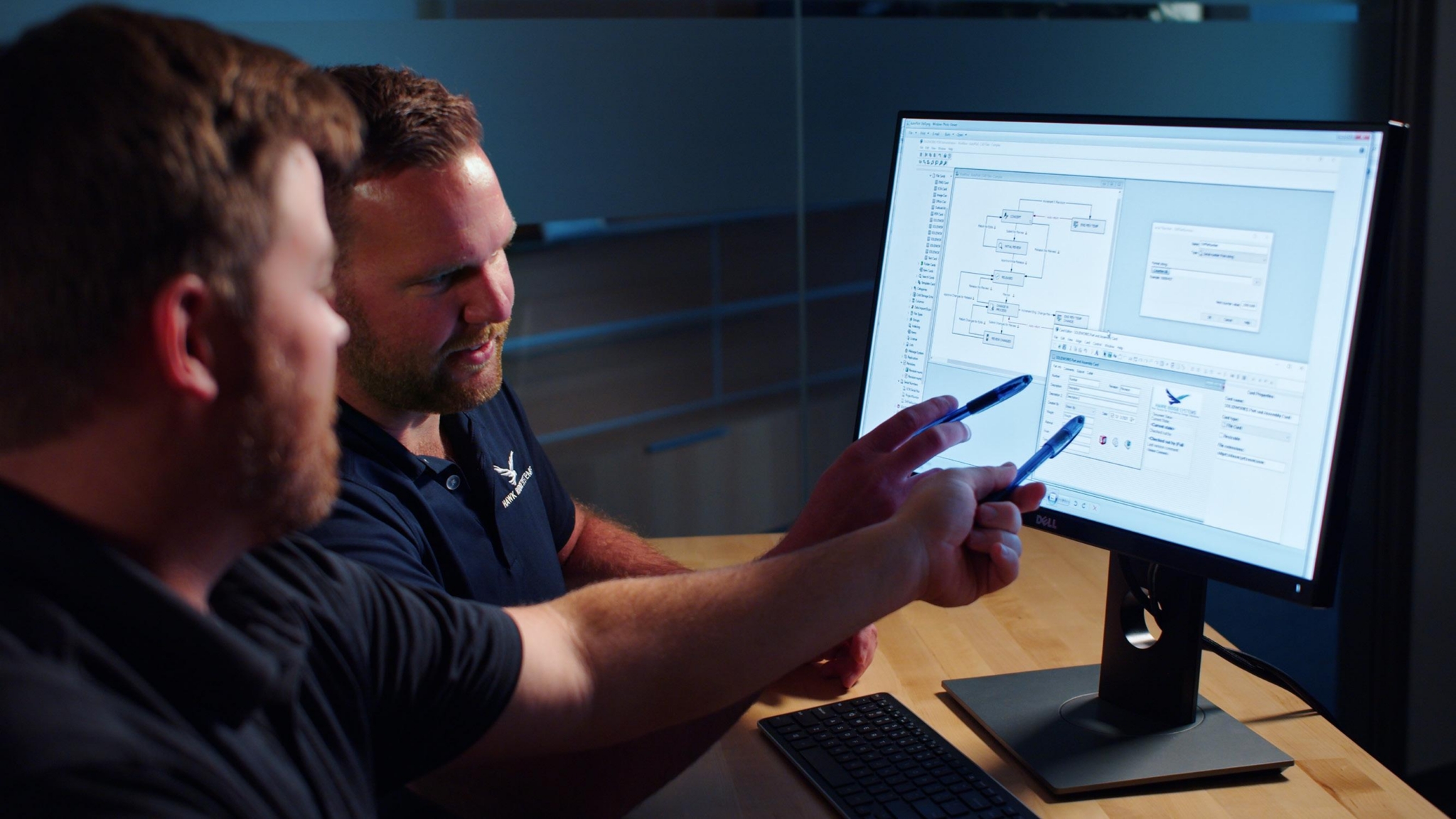
AI in manufacturing pays off after you connect trustworthy product and production data – the digital thread – not before. In this Hawk Ridge Systems webinar, Cameron Carson, Senior VP of Engineering at Hawk Ridge Systems, lays out a four-level AI adoption model, and Tim Felbinger of StartProto shows an AI manufacturing operating system working on that connected data for quoting, orders, purchasing, and the shop floor.
Carson says governance and the digital thread sit under every stage of AI adoption. Felbinger then demos StartProto extending that connected picture into day-to-day manufacturing work.
Key Takeaways
- Treat AI adoption as levels, not a single leap – from fundamentals and built-in tools to deployed systems and, later, agentic workflows across the business.
- Governance and the digital thread sit under every level. Fix broken processes before you scale them, and give AI connected, trustworthy data with real context.
- A digital thread is a capability you build, not a product you buy. Product lifecycle tools each own a slice – CAD, CAM, PDM, ERP, MES, and more – so gaps between systems turn into rework.
- StartProto is an AI manufacturing OS for day-to-day manufacturing work across OEMs, contract manufacturers, machining, and aerospace and defense – a way to extend connected data into operations.
- Useful shop-floor AI needs unified context. StartProto stores manufacturing relationships so agents can work from engineering through quoting, purchasing, and production.
- You do not have to rip out CAD or PDM to get started. StartProto is built to work with the design systems you already use, and it may replace or sit alongside ERP depending on where you are today.
Watch the Full Webinar
Webinar chapters
- 0:00 – Welcome and agenda
- 1:26 – Hawk Ridge Systems AI adoption model
- 3:05 – Level 0: AI fundamentals
- 3:33 – Level 1: Built-in AI (AURA and LEO)
- 4:41 – Level 2: Deployed AI
- 5:46 – Level 3: Transformation
- 6:21 – Foundation: governance and the digital thread
- 10:05 – Three things worth doing at every stage
- 11:01 – Why StartProto fits the model
- 12:03 – Tim Felbinger introduces StartProto
- 12:33 – StartProto as an AI manufacturing OS
- 22:13 – Demo: purchase order and drawing prompt
- 22:33 – Demo: jobs staged ready for release
- 26:48 – Q&A: Are we ready for AI?
- 29:53 – Q&A: Connecting tools like Claude
- 32:33 – Q&A: Guardrails and plan mode
- 38:30 – Q&A: Does StartProto replace CAD or PDM?
- 41:30 – IMTS and close
Why Manufacturers Feel Stuck on AI
Carson hears the same sentiment across design and manufacturing teams. Everything feels labeled AI. Leadership wants action. Budgets appear. So does FOMO. What customers ask Hawk Ridge Systems is more practical: how do we do this safely, how do we get ROI, and where do we start?
Hawk Ridge Systems answers that through the lens of the work its customers already do – design and manufacturing – and through a simple adoption model that keeps the conversation grounded.
The Hawk Ridge Systems AI Adoption Model
Adoption is not always a straight line. You might use advanced tools in one area while still building basic AI habits in another. Carson still finds it useful to name four levels.
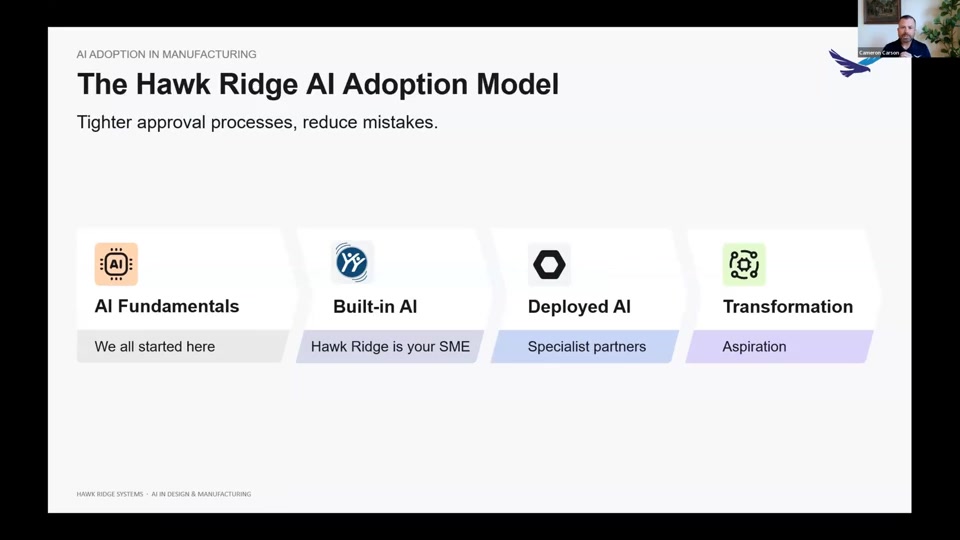
AI fundamentals. Most teams are here or recently were. People learn to write better prompts, put guardrails on chat sessions, and figure out which tools IT will allow on sensitive data. It is the literacy step everything else builds on.
Built-in AI. Assistance shows up inside the products you already run. In SOLIDWORKS, companions such as AURA and SOLIDWORKS LEO are part of that shift – AURA for cited guidance inside the CAD stack, LEO for agentic tasks such as drawings and macros. Dassault Systèmes has been adding machine learning and AI capabilities over time – often quietly – with more agentic design help still coming. Hawk Ridge Systems already acts as a subject-matter partner here; start with the AI for engineers and manufacturers hub for what is generally available today versus what is still in Beta.
Deployed AI. Systems sit on top of daily work and pull signal from ERP, SharePoint, PDM vaults, and other stores you already own. The promise is connections and analysis across large, messy data sets full of duplicate files, design-change context, requirements traceability, and metadata locked in old drawings.
Transformation. Agentic workflows span multiple systems with real orchestration. Carson is frank: very few businesses are seeing ROI here yet. Hawk Ridge Systems still sees it as a horizon worth preparing for, not a mandate to jump overnight.
What Every Level Rests On
Two foundations show up under every level.
First, governance. The people who run a process should own it, and the process should work before you automate it. Scale a broken process and you only get bigger problems.
Second, connected product data that stays true as it moves from one function to the next – with a clear source of record. That is the digital thread: the continuous flow of designs, revisions, BOMs, simulations, toolpaths, and production records across the lifecycle. It is not a single piece of software. It is a capability you build over time.
Carson’s point is the same one Hawk Ridge Systems makes across its SOLIDWORKS AI guidance: AI is a multiplier, not a shortcut around bad data. Connect trustworthy product data first, then let AI accelerate it. Garbage in still means garbage out – only faster.
From Fragmented Tools to a Connected Lifecycle
Most teams experience PLM as a software category. Carson reframes it as how a product moves through the business – concepts and requirements through design, engineering, manufacturing, quality, service, and retirement.
Along the way sit CAD, CAM, PDM, ERP, MES, MRP, QMS, and more. Each tool is strong in its lane. None of them owns the whole story alone. Data grows. Systems fragment. Gaps become mismatched processes and rework – the same handoff breaks that snap a digital thread.
For thirty years Hawk Ridge Systems has been the CAD, CAM, and PDM partner many manufacturers already trust. What “most capable” means now includes helping customers build the thread stage by stage – whether that starts with SOLIDWORKS PDM for revision control, extends with PLM (including options on the 3DEXPERIENCE platform), or reaches further into manufacturing and production. The advisory role stays the same: meet customers where they are, and be honest about what is ready for production.
Carson names three moves that pay off at every stage of the lifecycle.
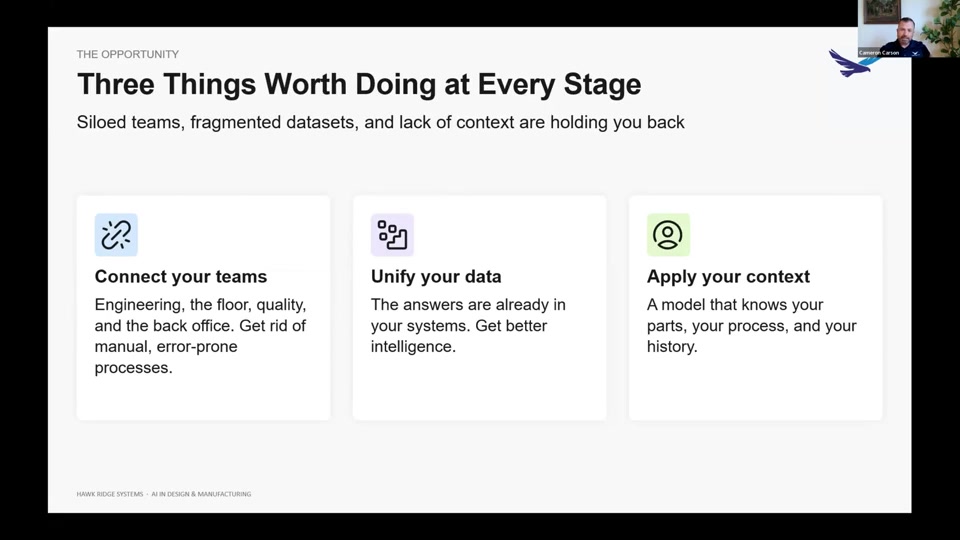
- Connect siloed teams – engineering, the shop floor, quality, and the back office.
- Surface insight from data you already own – design decisions, quote history, scrap reasons, cycle times.
- Apply your context and stay in control – models grounded in your parts, processes, and history.
StartProto as an AI Manufacturing OS
That is the bridge into StartProto. Carson describes it as accessible, ready for regulated environments where ITAR matters, and built with AI and agentic workflows from the start – so an AI agent can work against connected manufacturing data instead of a pile of spreadsheets.
Felbinger calls StartProto an AI manufacturing OS: one operating system for running the manufacturing business. The focus is OEMs, contract manufacturers, machining shops, and aerospace and defense work, with coverage across ERP, MRP, MES, and quality – and warehouse management for some larger customers.
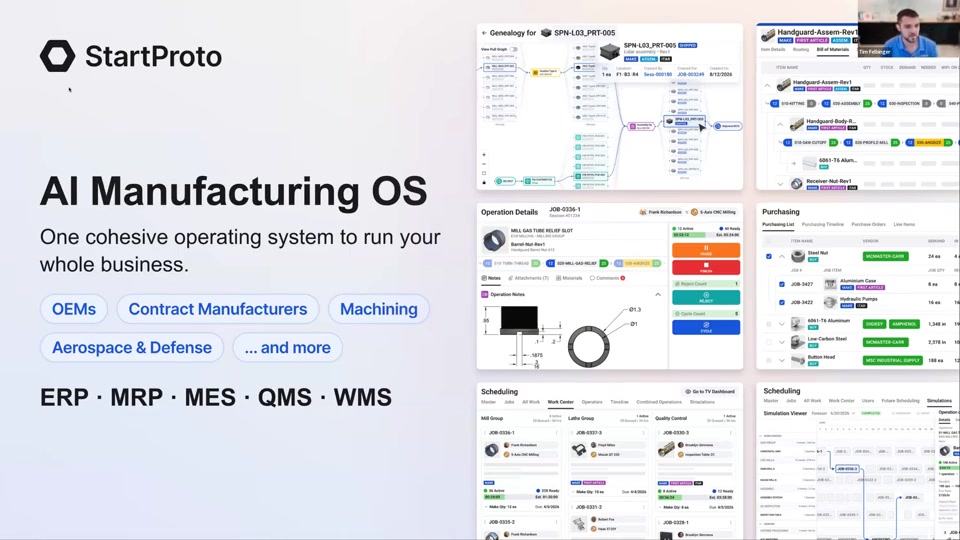
Important distinction: StartProto is not “the digital thread.” The thread is the broader capability of keeping product data continuous and trustworthy across the lifecycle. StartProto is a system that can extend that connected picture into day-to-day operations – quoting, orders, purchasing, and the shop floor – when manufacturing context is unified enough for AI to use.
The reality check is familiar. Headlines jump straight to lights-out robotics. On the shop floor, context is scattered across spreadsheets, personal drives, and “ask Jim.” That environment is hard for AI to use well. StartProto’s bet is to unify that operational picture – what Felbinger describes as a digital twin of manufacturing – so agents have something accurate to act on. In Hawk Ridge Systems terms, twins are the living models; the digital thread is what feeds them good data and keeps stages connected.
AI is still a statistical engine. Scheduling, work planning, and tight system links still need a platform that keeps the deterministic pieces honest. Agents then take on the work humans already do in the system: turning drawings or SOLIDWORKS files into routings and cost breakdowns, driving quotes from the same data, supporting purchasing decisions, and keeping the shop floor in the loop so plans match reality.
From a Purchase Order to Jobs Ready for Release
One example lands the idea. A customer forwarded a purchase order and drawing with a short prompt – review the PO, prepare the order, set up jobs with the right ship dates and process steps.
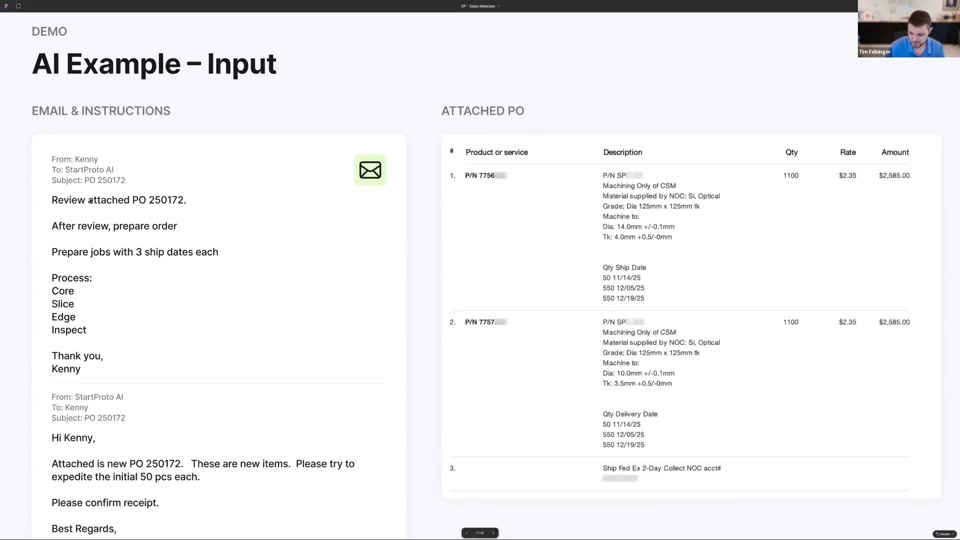
StartProto’s AI created the make items, built the routing, opened the sales order, and staged multiple jobs ready for release. The production team’s next step was approval, not retyping.
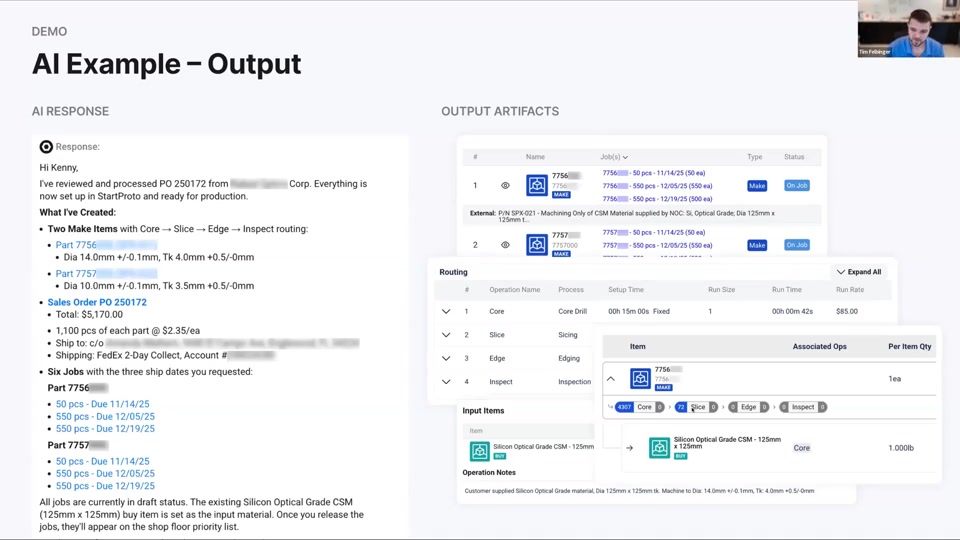
That pattern is why manufacturers bring a system like this in when skilled people are stuck in paperwork instead of making decisions. Felbinger notes customers who have grown top line significantly without greatly changing team size after migrating with StartProto and Hawk Ridge Systems support – especially when the starting point was spreadsheets and QuickBooks, or a legacy on-prem ERP that AI could not reach.
Questions Manufacturers Ask First
Do we need perfect data before we start?
Not perfection first – and not an all-or-nothing thread overnight. Carson and Felbinger both push discovery over delay: look at processes and data as they are, find where value is real, and build a path that does not scale chaos. Some AI use is available quickly in everyday tools. Deeper manufacturing value usually means connecting or modernizing the system of record, starting where the pain is highest.
What keeps AI from changing the wrong things?
Prompt quality, permissions, and review. StartProto’s plan mode has the agent research and present a plan for approval before it executes, often from a read-only default. Full audit history shows what changed, who (or which agent) changed it, and what it looked like before.
Does adopting StartProto mean ripping out CAD or PDM?
No. StartProto is CAD and PDM agnostic, so design tools stay in place. That matches how Hawk Ridge Systems talks about building a digital thread: PDM remains the usual anchor for files and revisions, while AI already shipping in SOLIDWORKS and 3DEXPERIENCE keeps accelerating work inside CAD, including drawing automation and LEO through the Virtual Companions.
For ERP, the answer depends. Sometimes StartProto replaces an end-of-life system that cannot support AI connections. Sometimes it runs operations and sends what accounting or a parent company still needs back into a modern system such as NetSuite.
Keep Learning: AI in CAD
For the SOLIDWORKS side of the stack – Virtual Companions, tokens, and what you can turn on today – start at Hawk Ridge Systems’ AI for engineers and manufacturers hub, then go deeper:
- AURA AI in SOLIDWORKS, according to engineers — practical AURA workflows and when to pair it with a general LLM
- Beyond the hype: what's new with AI in design — what is useful now versus promotional noise
- What is here today in CAD and 3DEXPERIENCE — built-in AI and platform capabilities you can enable without waiting on the Virtual Companions
- 3DEXPERIENCE: How to Start Automating Your CAD Designs with SOLIDWORKS AI — step-by-step AURA and LEO in the Virtual Companions
- Engineer's guide to SOLIDWORKS AI Blue Tokens — what prompts cost and how to route work across companions
- Automate drawing creation in SOLIDWORKS — templates, Auto-Generate Drawing, and LEO-assisted drawings
- How engineers are actually using AI in 2026 — documentation, troubleshooting, code, validation, and training patterns
- SOLIDWORKS goes all-in on AI — what 3DEXPERIENCE World 2026 signaled for LEO and the Virtual Companions
- 7 best ways to automate SOLIDWORKS designs — assistants plus the broader automation toolkit
- 5 things manufacturers can do now — adoption moves that do not boil the ocean
If you want help assessing AI readiness, connecting the tools you already use, or exploring StartProto with Hawk Ridge Systems, reach out to the Hawk Ridge Systems team.
FAQ
What is StartProto?
StartProto is an AI manufacturing operating system for running day-to-day manufacturing work – including quoting, orders, purchasing, production, and quality – on a unified data model so AI agents can act with real shop context.
What is the digital thread in manufacturing?
It is the continuous, connected flow of a product’s data – designs, revisions, BOMs, simulations, toolpaths, and production records – across the lifecycle, so every team and system works from one current source instead of scattered copies. It is a capability built on connected data, not a single product.
Is StartProto the same thing as a digital thread?
No. The digital thread is the broader capability of keeping product data connected and trustworthy across stages. StartProto is software that can extend that connected picture into manufacturing operations when the data and workflows are ready for AI.
Is a digital twin the same as a digital thread?
No. A digital twin is a virtual model of a specific thing – a part, machine, or factory line – kept in sync with the real one. The digital thread is the data flow that connects lifecycle stages and feeds those twins good data. In the webinar, StartProto’s manufacturing graph is described as a digital twin of manufacturing; it still depends on connected, trustwor dat.
What are the Hawk Ridge Systems AI adoption levels?
Four levels: AI fundamentals (prompts, guardrails, approved tools), built-in AI inside products you already use (including AURA and LEO in SOLIDWORKS), deployed AI across business systems and data stores, and transformational agentic workflows across multiple systems. Few manufacturers are realizing ROI at the highest level today.
Can StartProto work with SOLIDWORKS and existing PDM?
Yes. In the webinar, StartProto is described as CAD and PDM agnostic. Add-ins can pull a bill of materials from common CAD platforms and send that data into StartProto without replacing the design vault.
Is StartProto only for replacing ERP?
No. It may replace legacy ERP that cannot support modern AI connections, or it may augment a modern ERP by running operational flows while finance systems stay in place.
How do Hawk Ridge Systems and StartProto help teams start safely?
Through readiness conversations, honest guidance on what is production-ready, implementation support for mapping real shop data, and product controls such as plan mode and audit logs so people stay in the loop.