This month, the SOLIDWORKS community once again got the chance to come together in person and celebrate more than 30 years of success of their favorite 3D CAD tool. Always enthusiastic, some of the world’s best engineers came together in Houston, TX to share their opinions and find out what’s in store for the future of design and manufacturing tools.
Dassault Systèmes opened 3DEXPERIENCE World 2026 with a clear message: AI is not just a feature or add-in product; it’s a technology that can and should be powering the tools that engineers use every day, starting with SOLIDWORKS CAD. They framed this year as the “spark phase” of AI in engineering: technology has given us the fire, but we still get to build the furnace and cook the meal ourselves. SOLIDWORKS CEO Manish Kumar made his views clear, that AI isn’t here to replace us, but to supercharge our capabilities and allow engineers to make decisions with better and faster information. “AI is the multiplier. You are the value,” he said. Dassault Systèmes CEO Pascal Daloz echoed that sentiment: AI exists “to amplify what you do… to make you even more powerful”. [blog.3ds.com]
 Dassault Systèmes opened 3DEXPERIENCE World 2026 framing AI as core to how SOLIDWORKS CAD will work going forward.
Virtual Assistants: A Core Theme of 3DEXPERIENCE World 2026
A core theme this year was the idea of virtual assistants — agents who will assist designers, engineers, and researchers along the way and provide unique answers to the same questions depending on which persona is being asked. Expanding on the launch of AURA last year, which provides guidance and instruction for using SOLIDWORKS based on official documentation, LEO was introduced as the true engineer’s assistant — fully understanding engineering intent, standards, and physics. Upload a BREP body or 2D drawing, and LEO promises the ability to reverse engineer it into a full parametric model. Hand it a sketch, and it generates a ready-to-manufacture part. Need a detailed drawing? LEO filters through title blocks, identifies dimensions, and produces clean, standard-compliant documentation in moments.
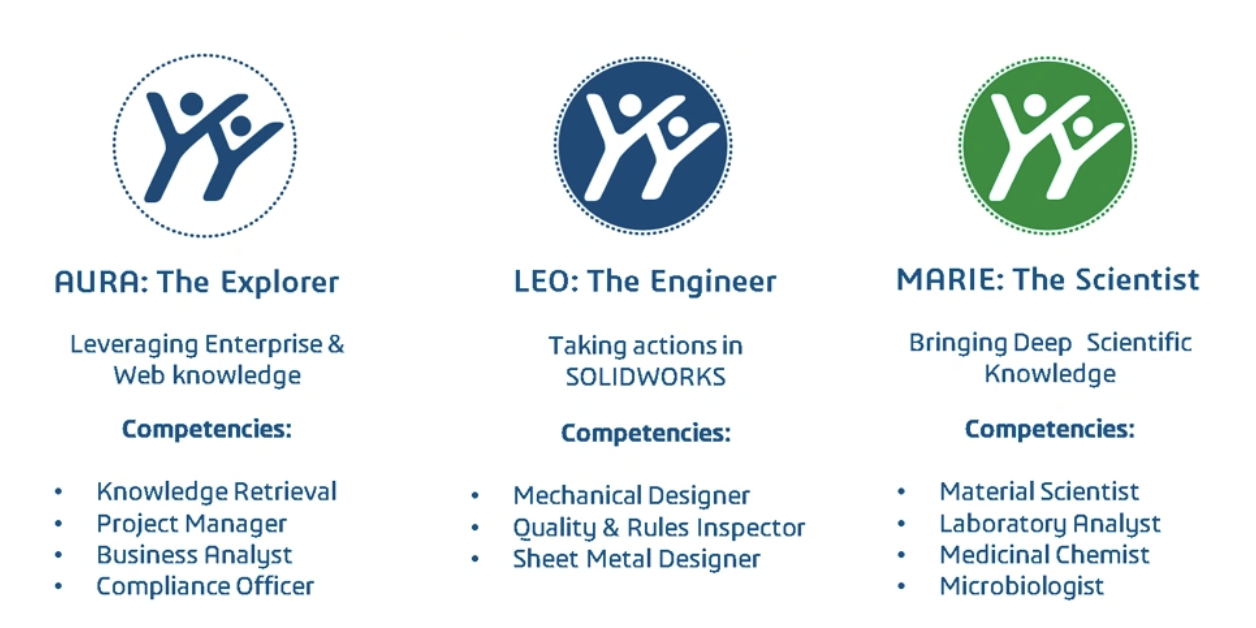
This level of automation in CAD modeling is eye-opening, but the potential doesn’t stop there. LEO can create issues or change actions in 3DEXPERIENCE to help streamline the approval process for everyday engineers, or even set up advanced explicit-dynamic FEA simulation workflows utilizing the SIMULIA Abaqus solver — all triggered by simple prompts or attached to design changes. It can also predict simulation results using surrogate models trained on prior validated cases, offering early insights without waiting for traditional solver runs. Worried about stress concentrations or failure points? LEO has the ability to flag them immediately.
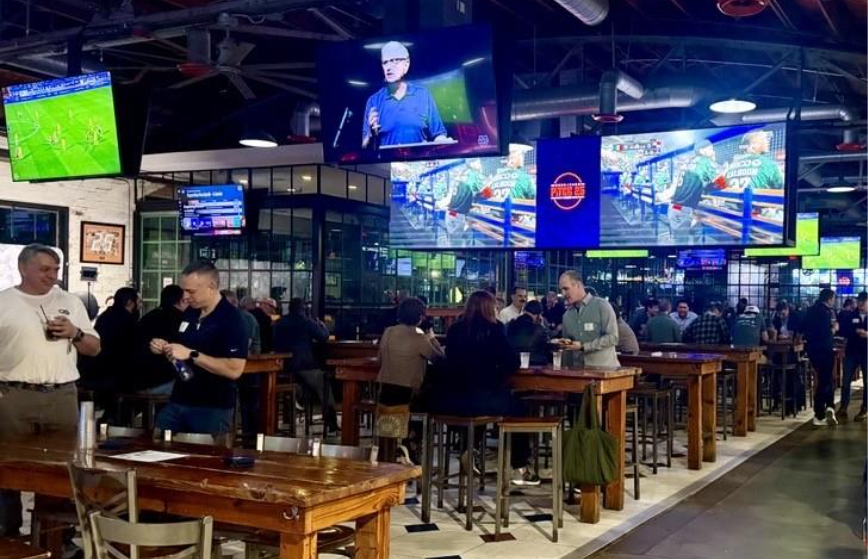 Hawk Ridge Systems hosted a customer appreciation event at Pitch 25 alongside the buzz from 3DEXPERIENCE World 2026’s AI announcements.
It’s fair to say that these announcements on day 1 were all the buzz, and a hot topic at the Hawk Ridge Systems customer appreciation event held at Pitch 25. Ever since the release of AURA last year, which was a welcome addition to the AI enhancements already added to SOLIDWORKS, we’ve been keeping our customers up to speed with the present and future state of these technologies through articles on the Hawk Ridge Systems blog and events like our Speed to Innovation series and D2M Conference. Everyone was still surprised and excited about the pace of progress, and the fact that these tools and technologies are already being released.
Dassault Systèmes & NVIDIA
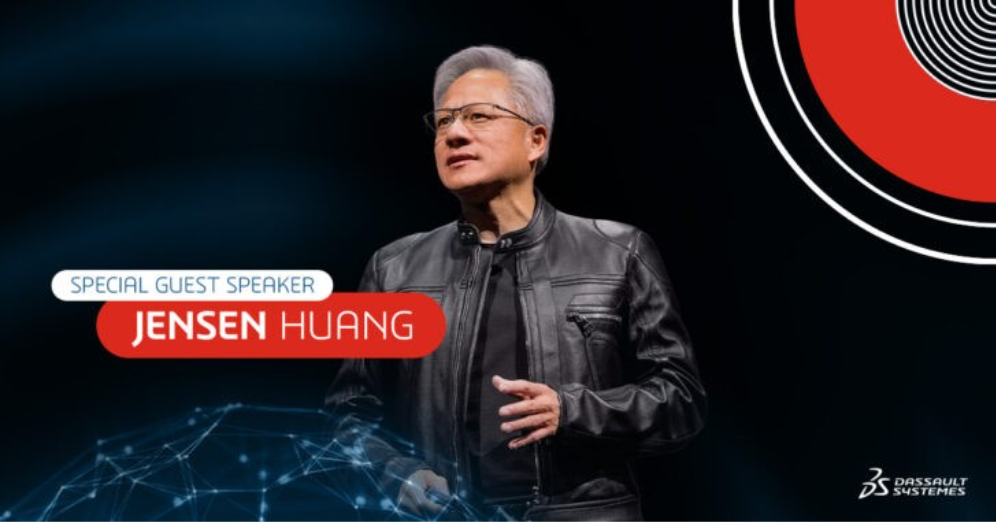
Behind all this, Dassault leaned hard on its partnership with NVIDIA. On day two, Pascal Daloz and NVIDA CEO Jensen Huang took the stage to unveil a vision they’re calling “physical AI”: AI that knows physics and causality, built on NVIDIA’s Omniverse platform, accelerated libraries, and open models. This is not just talk about GPUs — their aim is to build industry world models, digital twins that reflect real-world behavior with physics-driven accuracy, powering every virtual companion within the 3DEXPERIENCE platform. [blog.3ds.com]
NVIDIA is quick to point out that while their cutting-edge hardware continues to power the datacenters of the future, it’s also their AI libraries underpinning many of these technologies, such as the ability for LEO to reason with physical laws as it interprets geometry and sets up simulations, helping it predict behavior, propose design changes, and even refine mesh setups without human intervention. And because these models recognize digital twins stored in 3DEXPERIENCE, companies will have the options to take every part or assembly they generate — plus its simulation history — to further train the model and build a knowledge base specific to their design intent, methods and standards.
What this means for SOLIDWORKS engineers is a potential explosion in productivity. Instead of spending hours recreating supplier drawings, cleaning up imports, or grinding through simulation setups, you’ll be able to build parametric models, get instant engineering feedback, dispatch simulations, and document change in fluid workflows with significantly less formal training. That promises to free engineers to focus on what really matters: creativity, optimization, and value-driving innovation.
Perhaps the most poignant example of all this was at the end of the day 2 General Session, when Manish Kumar offered a glimpse at the true promise of LEO. Launching SOLIDWORKS 2026 with LEO running alongside the task pane, he input a simple prompt:
“I need to design a SOLIDWORKS model for a steel structure frame to support a water tank with the following specifications considering all types of load situations including load due to winds in Massachusetts, USA.”
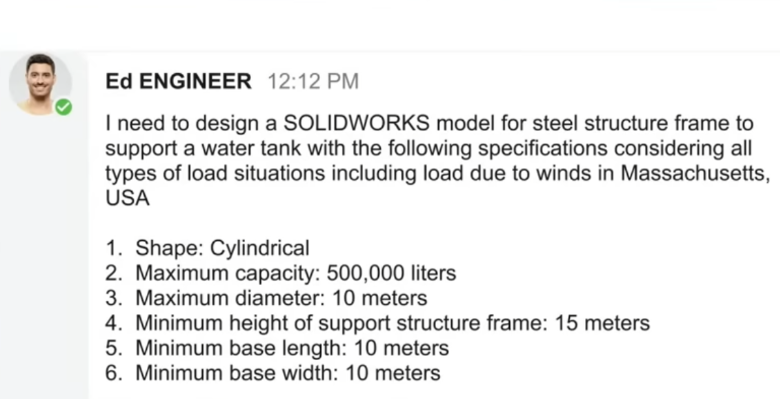 At 3DEXPERIENCE World 2026, LEO was prompted to design a steel structure frame for a water tank under Massachusetts wind load conditions.
Many of us in the audience were expecting LEO to provide some advice on how to design a water tower, or maybe tips on how to utilize the Weldments features in SOLIDWORKS. Instead, this new AI assistant proceeded to build the Assembly for this new product, generate 3D sketches and Structure System features to model the components, validate them with a Linear Static study in SOLIDWORKS Simulation, and report on key Mass Properties and other parameters of the resulting design — weight, height, footprint, Factor of Safety, and more. All of this, Manish claimed, was generated in under 5 minutes of processing time. While there are surely different opinions on whether the result was a good starting point, and while most engineers would surely spent hours tweaking the design or editing the parameters, the ability to generate a mode like this in minutes instead of hours was rather astounding.
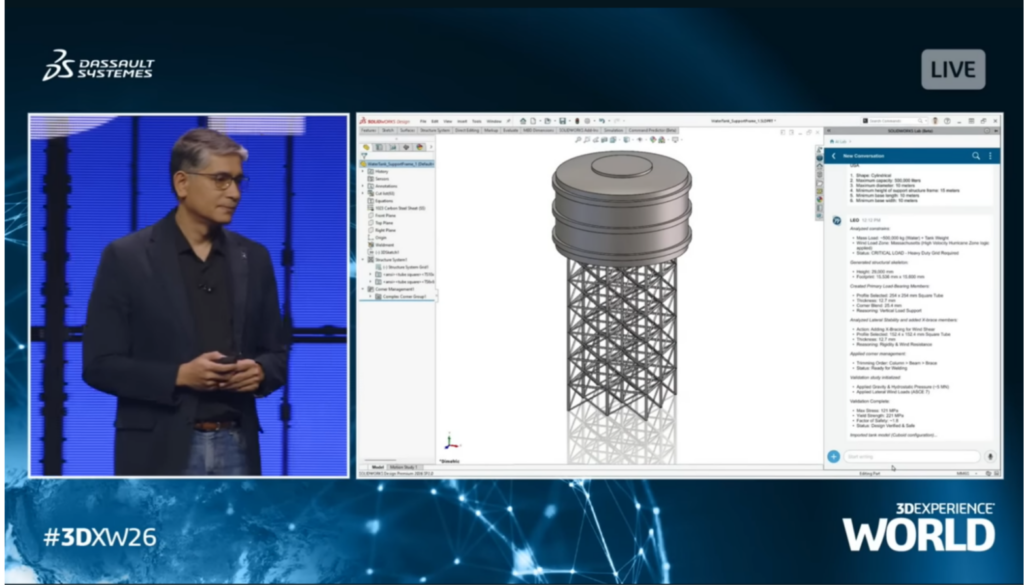 Rather than offering design tips, LEO built the assembly, generated 3D sketches, and created structure system features for the water tank on its own.
What’s Next: A Physics-Aware, AI-Powered Design Partner
Altogether these technology demos argued a convincing point: Used wisely, LEO and its AI companions become not just assistants, but true collaborators. They help enforce standards, automate documentation, accelerate analysis, and capture organizational knowhow. They promise to become a multiplier effect for engineers everywhere and help SOLIDWORKS users become even more productive with the tools they have enjoyed for years.
The shift we saw at 3DEXPERIENCE World 2026 isn’t incremental, it’s foundational. SOLIDWORKS is evolving with the times and augmenting our favorite CAD tool into a physics-aware, AI-powered design partner. The combination of Dassault’s industrial software maturity, SOLIDWORKS’ vast user base, and NVIDIA’s computation power sets the stage for a new era — one where engineers are freed to do the work that matters most.
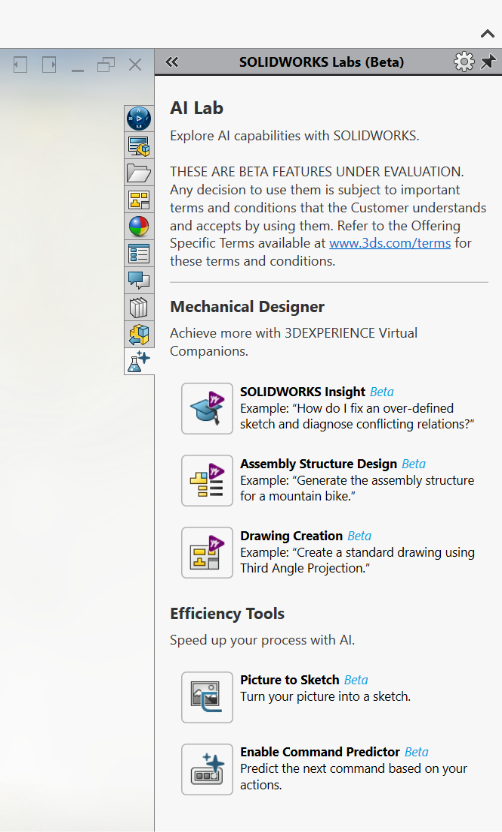 SOLIDWORKS is evolving into a physics-aware, AI-powered design partner following the announcements at 3DEXPERIENCE World 2026.
This is more than a roadmap. With the release of SOLIDWORKS 2026 SP1, some of these tools, including LEO’s assembly structure creation and the automatic BREP-to-features conversion in SOLIDWORKS xDesign, are already available. If you want to get started, those of you who have installed the latest SP1 upgrade from the 3DEXPERIENCE Platform can access some of these new tools from the SOLIDWORKS Labs tab in the Task Pane on the right hand side of your screen. As always, stay tuned to the Hawk Ridge Systems blog for more details on these tools as they are released.