Automation is no longer a future initiative; it’s a present-day imperative.
Labor shortages persist. Cost pressure continues. Customers expect faster delivery, higher quality, and greater customization. To tackle these, adoption of automation trends in manufacturing is accelerating across both design and production workflows.
The manufacturers who are succeeding aren’t just adding isolated tools. They’re connecting automation across the entire design-to-manufacturing (D2M) lifecycle.
Here’s what’s shaping U.S. manufacturing automation trends and the future of automation in 2026 — and where forward-thinking organizations are focusing next.
Why Automation Is at a Tipping Point
Automation has been part of manufacturing for decades. What’s different now is scale, integration, and urgency.
In the past, automation was often deployed in isolated pockets. Today, automation is no longer incremental. It’s systemic. Manufacturers are rethinking entire workflows, from initial design through final inspection, and connecting automation across departments rather than optimizing one step at a time.
Three major forces are driving adoption:
- Labor gaps
Skilled machinists, programmers, and engineers remain in short supply. As experienced professionals retire and recruiting pipelines struggle to keep pace, manufacturers must capture knowledge in software and standardize processes to reduce dependency on manual expertise.
- Reshoring initiatives
Bringing production back to North America requires greater efficiency to remain competitive with global labor markets. To protect margins, domestic manufacturers must offset higher labor costs with smarter automation.
- Competitive pressure
OEMs expect faster iteration, more variants, tighter tolerances, and flawless execution. The ability to respond quickly — without sacrificing quality — has become a defining competitive differentiator.
There’s also a growing expectation of data transparency and traceability.
“Today’s customers increasingly expect to see inside the process — they want real-time insight into when their orders will be ready, proof that compliance standards are being met, and hard data on how well things are performing,” says Doug Maatman, CSWE, Enterprise Senior Services Specialist at Hawk Ridge Systems. “Automation is what makes that level of transparency achievable, because it ties disparate systems together and replaces the fragmented, error-prone world of manual data management.”
Manufacturers can’t simply hire their way out of these challenges. They must automate strategically. Not just to reduce labor, but to increase agility, protect institutional knowledge, and create a robust, scalable operation.
Trend #1: Design Automation Goes Mainstream
Automation no longer starts on the shop floor. It starts in CAD.
In 2026, the design phase is recognized as the highest leverage point in the entire manufacturing lifecycle. Errors introduced early multiply downstream. Delays in engineering ripple into production. Forward-thinking manufacturers understand that if automation begins at the source, everything that follows becomes faster, cleaner, and more scalable.
DriveWorks & Configuration Automation
Manufacturers dealing with “same but different” product variations are turning to configuration tools like DriveWorks to eliminate repetitive engineering work.
“Excessive manual work continues to consume valuable engineering capacity, slowing innovation, and limiting growth,” says David Kelly, CDWE, Enterprise Solutions Services Specialist at Hawk Ridge Systems. “They must be equipped with tools that eliminate errors and low-value work to enable them to solve more meaningful problems.”
So instead of manually adjusting:
- Dimensions
- Drawings
- Bills of materials
- Manufacturing documentation
Design rules are captured once and applied automatically across product variants.
This is critical in industries with high product variability such as automotive aftermarket, consumer products, custom machinery, and engineered-to-order environments.
“Automation tools like DriveWorks remove the repetitive workload that consumes engineering capacity, enabling highly skilled engineers to focus on custom solutions, product development, optimization, and other high-value initiatives,” says Kelly.
When design logic is embedded into automation tools, companies reduce dependency on tribal knowledge and eliminate bottlenecks tied to specific engineers. Kelly adds, “Companies can dramatically reduce manual effort while improving quality, consistency, and throughput.”
The result? Faster quoting. Fewer errors. More scalable customization. And just as importantly, a consistent, repeatable design process that supports growth without increasing headcount.
AI in Design Automation
AI-assisted modeling helps identify potential design conflicts, recommend manufacturable geometries, and accelerates early-stage concepting. What once required multiple iterations and manual refinement can now be achieved in a fraction of the time.
From feature suggestions to generative design capabilities, engineers can now:
- Automate repetitive modeling steps
- Explore optimized geometries faster
- Validate performance earlier in the process
Automation isn’t replacing engineers. Design automation trends are about eliminating busy work so they can focus on complex problem-solving and strategic design decisions. The goal isn’t fewer engineers — it’s more empowered engineers producing higher-value outcomes.
Trend #2: More Automation on the Shop Floor
Automation continues to grow into all areas of production, starting with design.
But a competitive advantage doesn’t come from fast design alone; it comes from seamless execution. When CAD, CAM, and shop floor systems are integrated, manufacturers eliminate friction between departments and dramatically reduce delays caused by miscommunication or manual programming errors.
H3: CAMWorks & Automated CNC Programming
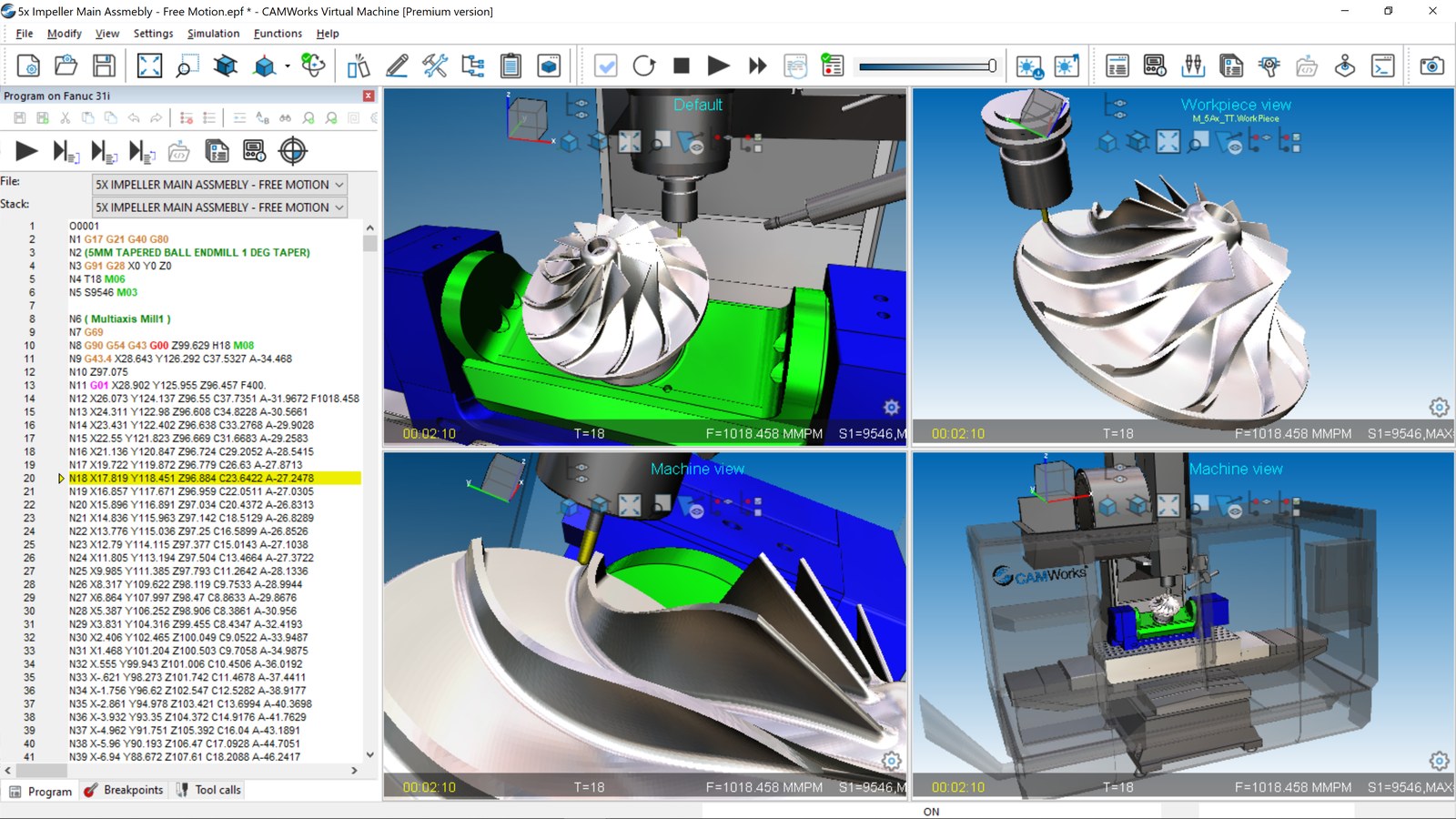
Integrated CAD-to-CAM workflows are becoming standard. Tools like CAMWorks enable:
- Automatic feature recognition
- Rules-based machining strategies
- Standardized tool libraries
- Faster NC code generation
“When machining logic is built directly into the design environment itself, the long-standing gap between what engineers envision and what the shop floor can produce begins to close,” says Maatman. “Rather than treating design and manufacturing as two separate handoffs, intelligence lives where the work begins — keeping both sides in sync from the start.” Toolpaths update when designs change. Programming standards remain consistent across teams.
It also captures institutional knowledge, which is critical when experienced machinists are nearing retirement. Instead of relying on memory or handwritten notes, machining best practices are codified into the system itself.
Robotic Machining & Toolpath Optimization
Manufacturers are deploying advanced industrial automation solutions on the shop floor to boost productivity and reduce dependency on manual labor. Common implementations include:
- Robotic machining cells
- Lights-out production strategies
- Automated scheduling systems
- High-speed toolpath optimization (such as VoluMill-style strategies)
Robotic machining cells allow for precise, repeatable operations with minimal human intervention, while lights-out production strategies enable machines to run unattended for extended periods — often overnight or across full shifts — dramatically increasing spindle uptime and overall output.
Automated scheduling systems provide real-time visibility and dynamic resource allocation, helping factories respond quickly to changing demands, without constant oversight.
High-speed toolpath optimization further enhances performance by generating efficient cutting paths that significantly reduce cycle times, lower tool wear, and improve surface finish quality.
Using robotics and intelligent optimization on the shop floor means fewer manual handoffs between operations, greater process consistency, and improved scalability. These technologies allow manufacturers to maintain high quality standards even as they increase production volume or handle more complex parts — while simultaneously addressing ongoing labor shortages.
Trend #3: Digital Twin, Virtual Twin & Simulation-Driven Manufacturing
Manufacturers are no longer waiting until production begins to validate product designs and manufacturing processes. Instead, they are building simulated representations of their products, equipment, and even entire facilities, then testing them virtually to ensure performance — before a single physical asset is installed.
Using simulation tools such as SOLIDWORKS Simulation, SIMULIA, and DELMIA Factory Simulation, manufacturers reduce rework, scrap, unplanned downtime, and costly layout changes.
Simulation extends well beyond final validation. Integrated with virtual twins, it enables automation systems to be engineered, tested, and optimized against a realistic digital representation, providing faster deployment and more predictable performance.
Trend #4: Smart Factories & Connected Systems (IIoT)
True scalability comes from connectivity across machines, software platforms, and teams. Industrial automation trends show that today manufacturers are prioritizing integrated ecosystems where information moves in real time across the entire operation.
DELMIA & Smart Factory Orchestration
Modern manufacturers are using tools like DELMIA, AI-driven manufacturing workflows, and connected data platforms to orchestrate:
- Production scheduling
- Resource allocation
- Robotic workflows
- Shop-floor visibility
“Connected systems also create a much clearer record of what happened, when, and who was responsible — bringing a new level of accountability and end-to-end visibility to the production process,” says Maatman. “Every task, material movement, and production milestone is recorded within the system, providing greater transparency and control across operations.”
The Rise of the Digital Thread
The “digital thread” connects:
Design → Simulation → Manufacturing → Inspection → Lifecycle Data
Instead of information being trapped in departmental silos, data travels with the product from concept through production and beyond. Engineering changes automatically update downstream documentation and manufacturing instructions. Inspection results feed back into design improvements.
This also reduces errors caused by outdated files and disconnected systems. “When data moves freely across the entire operation, teams can pivot quickly and make more confident decisions — without waiting on information that’s stuck somewhere upstream,” says Maatman. This level of connectivity increases agility and supports faster decision-making across the organization.
Automation success depends on connectivity as much as machinery. Smart factories are not defined by robots alone, but by how well their systems communicate and operate as a cohesive whole.
Trend #5: Human + Machine Collaboration
As manufacturing automation trends influence workflows, the role of the workforce becomes more strategic. The companies seeing the greatest return from automation are redesigning roles to focus on oversight, optimization, and innovation.
Empowering the Workforce
When repetitive programming, documentation, and inspection steps are automated, teams gain time to focus on continuous improvement and problem solving.
The most successful manufacturers use automation to reduce repetitive tasks, capture institutional knowledge, and then train employees on higher-value skills.
“Expertise that previously belonged to a handful of veteran employees — and walked out the door when they retired — gets codified into the systems themselves, where it can be accessed by anyone, built upon over time, and scaled across the entire organization,” adds Maatman.
Upskilling for Hybrid Workflows
Hybrid human-machine workflows are the new normal. Engineers configure instead of manually redrawing. Programmers validate instead of hand-coding. Operators oversee robotic cells.
AI in factory automation supports this shift by handling those repetitive tasks while humans focus on higher-value work.
This shift improves retention, too. Employees are more engaged in solving meaningful problems than performing rote tasks.
Training programs now emphasize digital fluency alongside technical trade skills. Teams are learning to interpret data dashboards, manage automation rules, and collaborate across connected systems. The goal is not to replace craftsmanship, but to enhance it with digital tools.
Automation as the Backbone of Accelerating Innovation
Manufacturing automation trends and the future of automation now revolve around connected ecosystems that deliver exponential gains in speed, quality, and agility.
Automation is no longer a competitive advantage. It’s foundational.
Manufacturers that connect design automation, simulation, automated CNC programming, factory orchestration, and digital thread systems are:
- Reducing time-to-market
- Increasing throughput
- Improving quality
- Protecting margins
Isolated automation tools create incremental gains. Connected automation ecosystems drive exponential ones.
The future of manufacturing isn’t just automated. It’s connected.
Ready to Build Your Automation Ecosystem?
At Hawk Ridge Systems, we help manufacturers build integrated automation strategies from DriveWorks configuration to CAMWorks programming, from simulation-driven validation to DELMIA-powered smart factories.
Explore how Hawk Ridge Systems helps manufacturers design, implement, and support connected automation trends across the entire D2M lifecycle. Talk to an automation expert today.