We put a question to the people at Hawk Ridge Systems: What counts as damned good engineering that also passes as art? What we got back was a catalog of obsessions. This is just a thin slice of engineering excellence. Here are the 12 builds our team swears are equal parts engineering and art. (Want to color them in? Get the free engineering coloring book.)
Engineering as art, before CAD existed
Applications Engineer Nick Keglovits didn’t hesitate when asked which famous project he’d travel back in time to work on. “The Golden Gate Bridge: what a marvel of technology and beauty to this day, and before computer-aided design to boot.”
That last clause is the whole point. The bridge was drawn by hand, calculated with slide rules, and raised over a strait engineers of the era called impossible to span — no CAD model, no simulation, no digital twin. It held the record for the longest suspension span in the world until 1964, and it was built to move: the roadway can swing as much as 27 feet to the side in high winds. Nearly a century on, it’s still the first thing most people picture when they picture a bridge.

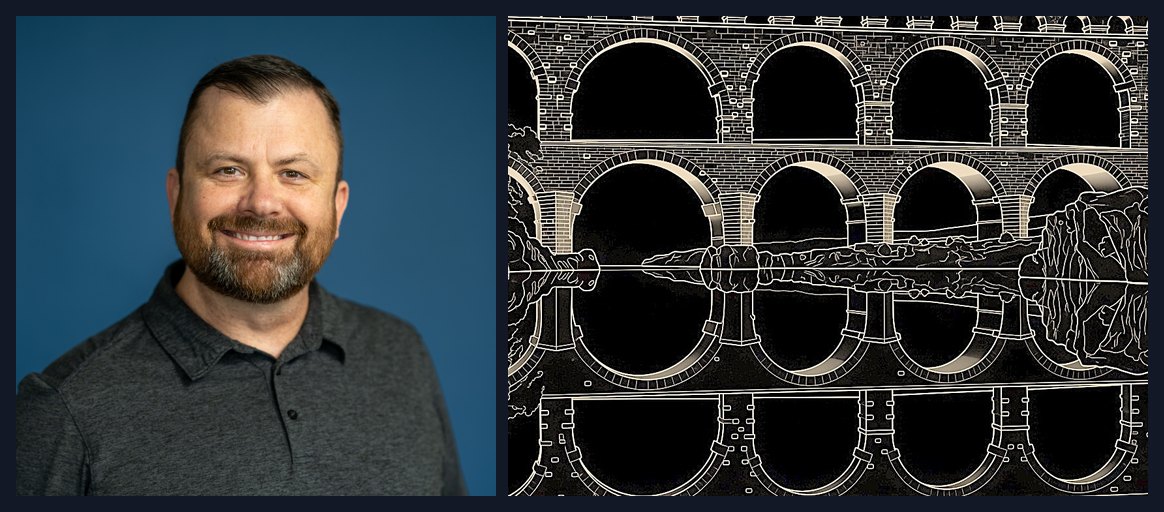
Cameron Carson, Senior VP of Engineering, reached back even further, to the Roman aqueducts — specifically the kind of structure embodied by the Pont du Gard. The Romans moved water across whole landscapes on a grade so gentle it’s hard to believe gravity did the rest. The Pont du Gard was part of a 50-kilometer channel that fell barely 12.6 meters end to end, yet delivered tens of thousands of cubic meters of water a day. Built from cut stone with no mortar, much of it still stands today. That’s the quiet flex of great construction: it doesn’t just impress its own generation, it keeps working for the ones who forgot how it was built.
Aircraft that double as art: the SR-71, F-117, and F-22
If there’s a spiritual home for engineering-as-art on this team, it’s Lockheed’s Skunk Works. Taylor Hoff, Applications Engineer III, named Skunk Works by Ben Rich as the book every engineer should read — the inside account of how a small team led by people like Kelly Johnson designed the SR-71 Blackbird, the U-2, and the F-117A: “engineering challenges, political influences, and development processes of these aircraft that were hugely impactful, both in the engineering world and with the history of the US post-WWII.” The Blackbird is still the fastest air-breathing crewed aircraft ever built; its evasive move against a missile was simply to accelerate.
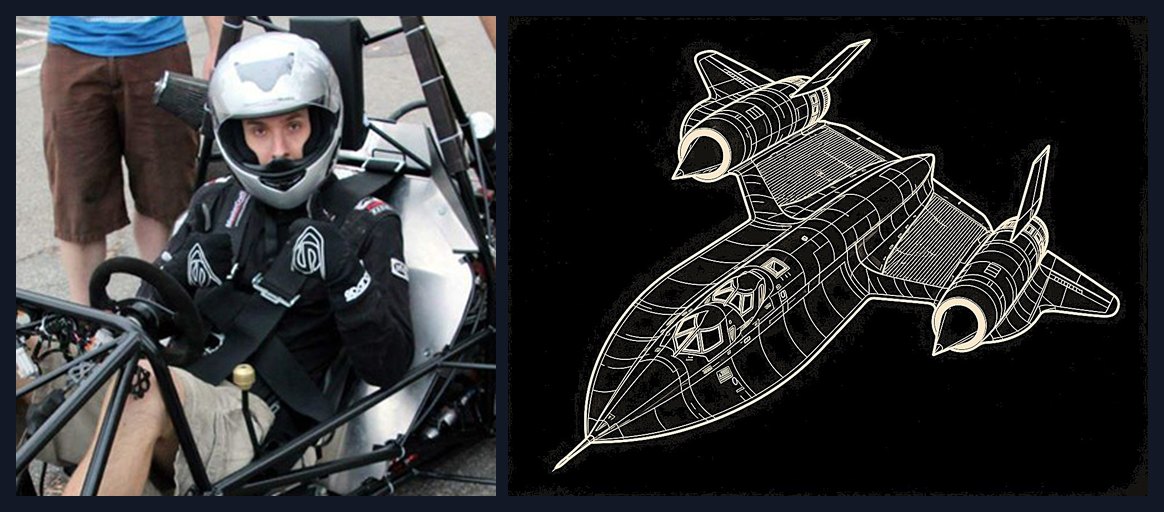
For Scott Woods, Senior Product Manager, 3DEXPERIENCE & Mechanical Design Tools, that history isn’t a book — it’s a memory. One of his earliest is standing at Beale Air Force Base in the early 1990s, watching the SR-71 retirement ceremony. “Even as a kid, I knew I was seeing something different,” he wrote. “Long, black, and impossibly fast, it felt like it came from somewhere else.” His father helped unveil the aircraft that day — a detail that meant little to Scott at the time and means everything now.
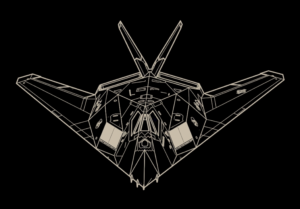
Over time, his pick shifted to the F-117 Nighthawk, the aircraft his father spent much of his career maintaining. The Nighthawk isn’t graceful — it’s angular, flat-surfaced, sharp-edged, “unfinished, almost,” in Scott’s words. But none of that is accidental: as the world’s first operational stealth aircraft, its body is built from flat facets that scatter radar away from its source, designed before computers could model curved stealth shapes. The SR-71 reflects speed; the F-117 reflects stealth. Same idea, opposite silhouettes.
What stays with Scott most isn’t the planes — it’s the people. His father retired from the Air Force as an E-7 Master Sergeant after working on the F-117, the F-15 Eagle, and the A-10 Thunderbolt II. “Behind every mission were maintainers, mechanics, and technicians. People whose names you don’t usually hear, but whose work makes everything else possible.” As he puts it: “Those aircraft became legends, but their success depended on thousands of people working behind the scenes. My father was one of them. For me, that’s where engineering becomes art.”

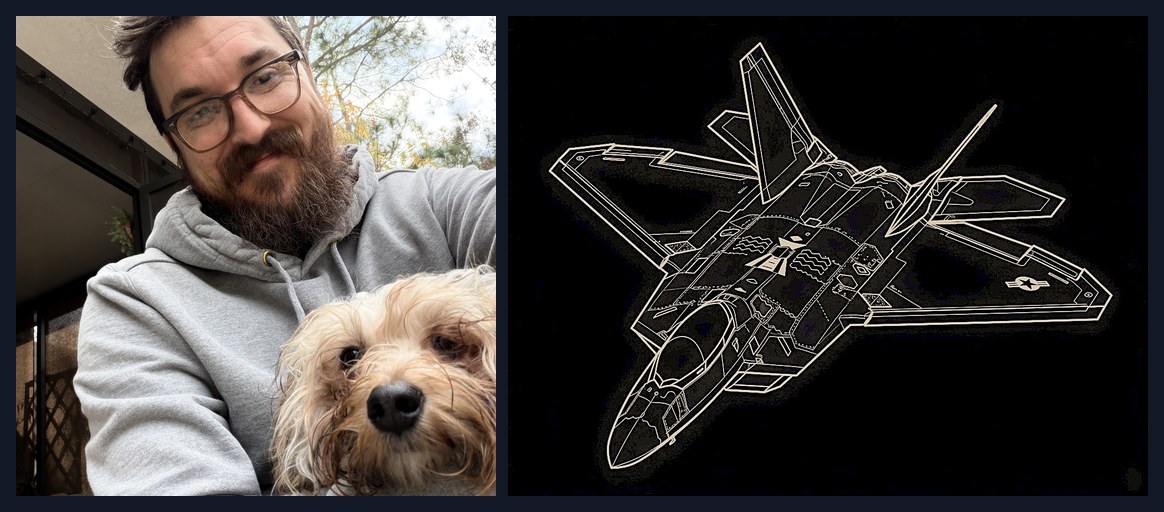
John Farmer, AI Engineer, kept it short and certain: the F-22 Raptor, hands down. A fifth-generation stealth fighter with thrust-vectoring nozzles, it can supercruise past Mach 1.5 without afterburners and point its nose almost independently of where it’s flying. Anyone who’s watched one stand on its tail and climb straight up understands the answer without further explanation.
Engineering as art that left the planet: the Space Shuttle, Starship, and Merlin engine
Applications Engineer Kenny Truong will defend the Space Shuttle against anything that flies, including the rocket that arguably made it obsolete. “The Falcon 9 can never touch the Space Shuttle in terms of just coolness,” he said. “It flies up and then it lands like a plane. Every other rocket just looks like a stick… But that one is just funny to me. It’s like a plane.” It’s a real engineering argument dressed up as a joke: the first reusable orbital spacecraft, shielded by roughly 24,000 silica tiles, gliding home unpowered from orbit at around Mach 25.

Its spiritual successor sits one plate over. SpaceX Starship is the tallest and most powerful rocket ever flown — 121 meters of stainless steel over 33 Raptor engines — and it’s designed to be fully reusable, landing both stages back near the pad.
Damon Tordini, Product Portfolio Manager, is excited about where that goes next. “It’s hard not to be excited about the rise of reusable launch vehicles,” he said — and he has skin in the game, having worked with Tom Mueller, the designer of the Merlin engine that powers SpaceX’s Falcon rockets. Nine Merlins power a Falcon 9 first stage, and the engine has among the highest thrust-to-weight ratios of any rocket engine ever built — and it’s made to fly again. Between Kenny and Damon you get the whole arc of the argument: the Shuttle’s beautiful, expensive grandeur and the lean, relentless iteration of the engines that followed it.

Engineering as art at human scale: watches, sculpture, and walking machines
Not everything our team admires is the size of a building or the speed of a bullet.
Patty Fogarty, Content Marketer, has always been fascinated by wind-up watches. “When you see them without their covers, they are so beautiful. So intricate and delicate.” She’s talking about the mechanical watch movement — dozens of tiny gears, each its own small work of art, that assemble into something almost philosophical. Some parts are thinner than a human hair; the balance wheel swings about five times a second, over 400,000 beats a day. “When you realize how all of those tiny pieces work together to create time, that’s amazing engineering.”

Matt Taylor, Senior VP of Marketing, went for Cloud Gate — the Chicago “Bean.” It’s officially art, which is exactly why it belongs here: 168 stainless-steel plates welded and polished until every seam vanished, leaving a single flawless mirror that warps the Chicago skyline into a liquid curve. The line between the sculpture and the engineering underneath it simply disappears.

Dale Ford, Chairman & CEO, brought it home — two of his picks are Hawk Ridge Systems customers, and both were built in SOLIDWORKS. The first is the Prosthesis exo-bionic racer, the largest controllable exo-bionic robot ever built: a ~15-foot, four-legged, all-electric machine with no AI, no autonomy, and no joysticks — the pilot stands inside a full-body exoskeleton and the machine mirrors their limbs, amplifying human motion across rough terrain.
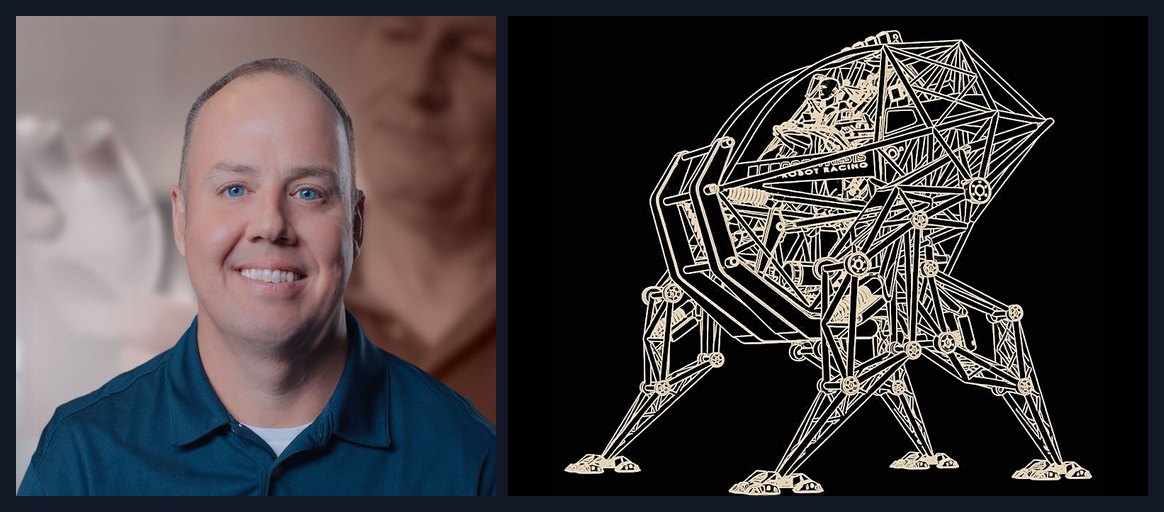
The second, from the same collective of artists and engineers, is the Mondospider — a rideable, ~1,700-pound, six-legged electric-hydraulic walking machine whose legs lift and place each foot in sequence to carry a passenger across rough ground. A racing mech and a giant walking spider, designed by people who plainly believe engineering and art are the same discipline wearing different hats. They’re not wrong.
The thread: where engineering becomes art
Look at the whole catalog and the pattern is hard to miss. A bridge and an aqueduct. A spy plane and a stealth fighter. A shuttle and the engine that replaced it. A pocket watch, a polished bean, a walking machine the size of a truck. Across two millennia and every scale we can build at, the same instinct keeps showing up: to make rather than take, to put order where there wasn’t any, to look at the impossible problem and pick up the tools anyway.
Download the free Engineering as Art coloring book
Loved these builds? We turned all 12 into a free engineering coloring book you can print and color in. Each page is a clean, detailed line drawing of an iconic feat of engineering and design — from a mechanical watch movement to SpaceX Starship — with a quick spec sheet and field note so you learn a little while you color.
It’s part engineering coloring book, part engineer’s sketchbook: a STEM-friendly, all-ages way to slow down and really look at how these machines are put together. Whether you’re an engineer who wants a mechanical-engineering coloring book for the desk drawer, a teacher looking for an engineering-and-design coloring book for the classroom, or a parent raising a future builder, every page is free to download below.
Color the full set (free PDF download)
Engineering as Art — the complete 12-page coloring book: Download the full engineering coloring book (PDF).
Download individual engineering coloring pages
- Plate 01 — Mechanical Watch Movement coloring page
- Plate 02 — SR-71 Blackbird coloring page
- Plate 03 — Space Shuttle Orbiter coloring page
- Plate 04 — SpaceX Starship coloring page
- Plate 05 — Liquid-Propellant Rocket Engine (Merlin 1D) coloring page
- Plate 06 — Pont du Gard Aqueduct coloring page
- Plate 07 — Golden Gate Bridge coloring page
- Plate 08 — F-22 Raptor coloring page
- Plate 09 — F-117 Nighthawk coloring page
- Plate 10 — Prosthesis Exo-Bionic Racer coloring page
- Plate 11 — Cloud Gate (The Bean) coloring page
- Plate 12 — Mondospider coloring page
Hawk Ridge Systems helps engineers and designers turn impossible problems into real products with SOLIDWORKS and 3DEXPERIENCE. See what our customers are building.