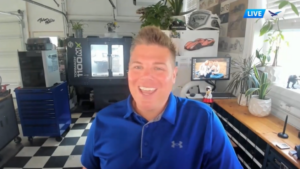
At our annual D2M Conference we interviewed Jason Pohl, Lead Industrial Designer and Brand Ambassador, to learn what he’s built with SOLIDWORKS and pick his brain about his design process. Watch the full interview on the D2M Conference webpage.
Creativity, Passion & The Design Process
Damon: Hey. Good morning, Jason. Thanks for taking some time out of your day to chat with us.
Jason: Yeah. It’s awesome to be here, Damon. Thanks for having me.
Damon: I think a lot of folks out in the Outreach audience today might be familiar with your work. They might have seen one of the bikes that you’ve designed, maybe saw you get into a spirited debate about one of them. I want to go back before all of that and find out, what is your background? How did you get into industrial design in the first place? What was your career path?
Jason: Sure. In my life, passion drives everything, And I guess when things started out, I was always about drawing and designing and building things. And I did it not just for me, but for the people around me. Because when I would show off a new painting or a new sculpture or a project, it would make people — it would bring joy to people. And that’s what it was about for me. It was all about getting joy and capturing fun. I feel like all designs, no matter what you work on, should provoke emotion and get people excited.
“Designs, no matter what you work on, should provoke emotion and get people excited.”
Damon: Likewise. Creativity is where it starts. Right? We’re coming up here in a few days on the official thirtieth anniversary of the first release of SOLIDWORKS. A lot of people have been sharing what the first model they ever made in SOLIDWORKS was. Do you remember yours?
Jason: I do. SOLIDWORKS gave me power. And at my old job at Orange County Choppers, it allowed me to make things in real life.
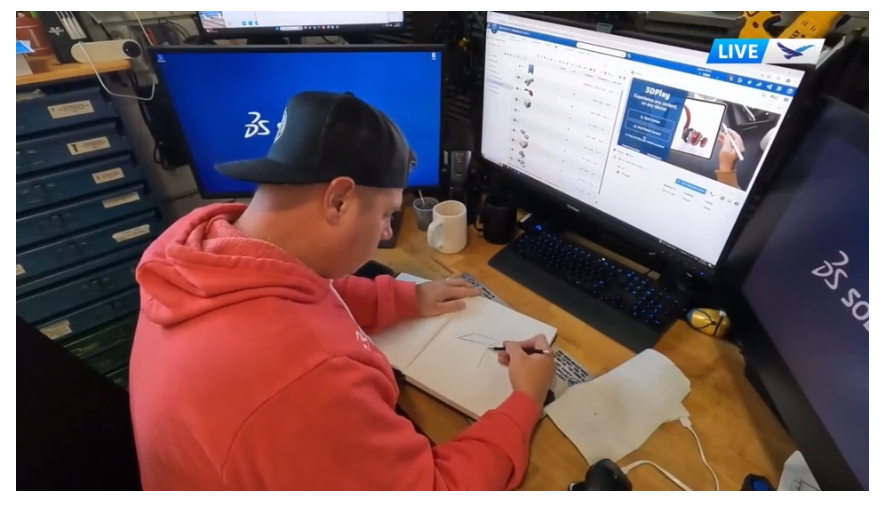
I was making these parts and going right to the water jet and blasting them and hanging it on the bikes, and it was — it just gave me power. So, I do remember my first [design]. My very first thing was just a very basic wheel. It was just a three-spoke design, very simple.
I look back at it now, get giggles, but it really — it allowed me to make my dreams possible. The first time you opened that a program like that, and you realized you could make almost anything, it — it was almost overwhelming. That’s how I felt.
Damon: Tell us about your design methodology. You’ve done many projects in your career. Where do you like to get started? Is it with that sketch? Is it with a pen and paper?
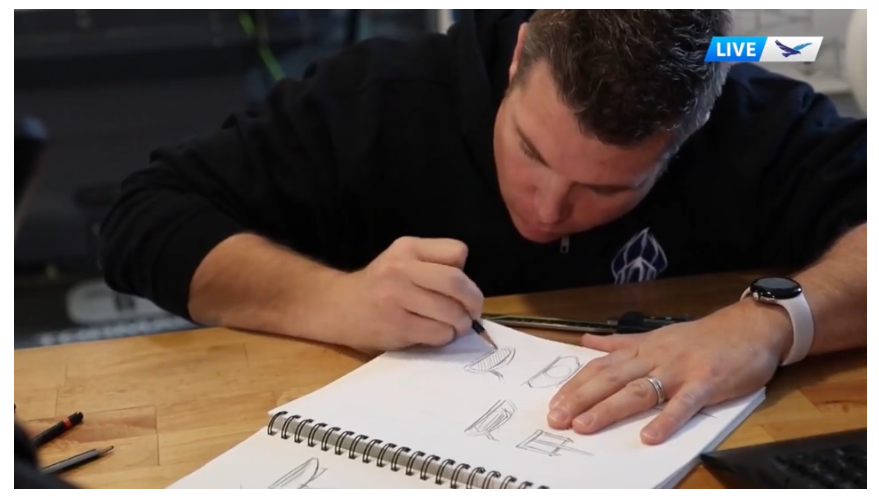
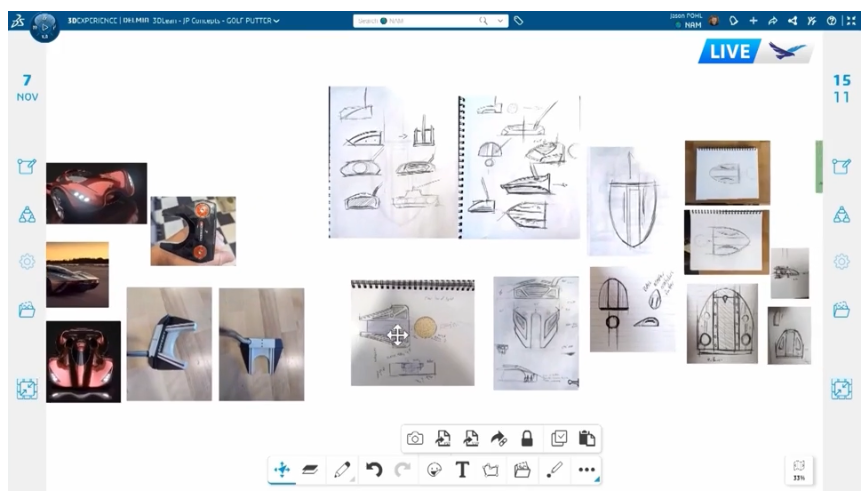
Jason: Yeah, a lot of times I’ll start with a pencil sketch and just sketch down a bunch of concepts. And then I build what’s called an art board where I take different shapes and colors. It could be cars, it could be other things that inspire me. I build an art board, and I’ve been doing that lately with the 3D Lean tool. And it’s great. I can just copy and paste pictures and add notes to it. That way I have that one resource that I can go back to and constantly draw inspiration. I put all my sketches from my sketchbook into the Leanboard, all the pictures that inspire me, and useful links for future ordering of materials that I’m going to need. It’s just super helpful. So that’s how I [get] started.
Damon: Yeah. Leanboard is one of those things that everybody with a license of SOLIDWORKS gets now. It’s not well known yet. I started using it for project planning earlier this year or even just reminders. It’s funny, right? You never think of SOLIDWORKS as having that kind of stuff. It’s a mechanical design tool, but it can do a lot.
Jason: It can do a lot. Getting started in projects, I used to have to flush out the design ahead of time with sketch, with markers, pencil and paper, and then go into the software and really sit down and focus.
But a lot of times, I find myself opening up xShape and just doing really quick concept models, because in the sub-D’s. I’m able to model so fast that sometimes that’s better because I see different shapes and contours in the 3D model that I can’t really express with just a pencil and a piece of paper. I often find myself jumping into xDesign, xShape, and just knocking out a quick concept in 3D space now.
Damon: Yeah. I remember struggling with how to do that in SOLIDWORKS back in the day when we didn’t have those sub-D modeling tools. I think my friend wanted me to design a ship base/spaceship for a video game for him or something like that. I’m like, I don’t think I can. Not the right way.
Jason: It’s all about the tools you have in your toolkit, right?
Damon: For sure. So, take me back. When you were just getting started, what were some of those early jobs where you used SOLIDWORKS to create some of this stuff?
Jason: I guess the first time I used SOLIDWORKS, because I came from the video game industry, it was all polygonal-based [designing]. I did some surface modeling too with splines. When I was introduced to SOLIDWORKS, I had an x y z to work from, and I had real numbers, so I could draw a perfect circle. And I knew that that was going to fit and be able to bolt on to the bike directly.
[One of the first big jobs we did with SOLIDWORKS:] We built a bike for Will Smith. It was called the iRobot. That was the very first bike that I was able to sketch and work on and design. And I remember making a shift linkage for it, and then I did what was called a suicide shifter. So instead of using the actual foot, you could just grab this handle that came across the gas tank and shift gears with it. And then, I got into doing mirrors and wheels, air cleaner covers, primary covers and frame design. I even at one point in my career, had a frame builder that I could punch in numbers and actually generate a frame that we’d then send to our fabricator to build.
The best thing about SOLIDWORKS [was that] I could always learn more. There was always more to know about it, and I just used a fraction of its power. I love to learn, so I’m still to this day learning new steps and new procedures and new ways of doing things inside SOLIDWORKS.
Damon: That’s pretty cool. Learning never stops, does it?
Jason: And you gotta stay fresh with it, and you’ll learn a new way to make something that looks cool, but has real numbers behind it, just like you said.
Damon: What are some of the other clients you worked with in your career? What are some of your favorites?
Jason: Oh, man. There [were] so many. Muhammad Ali was great to work with. Bill Murray, it turns out he — he was a mailman in Illinois, and so was I for one summer. So, we hit it off. He was great. We did the Caddyshack bike for him.
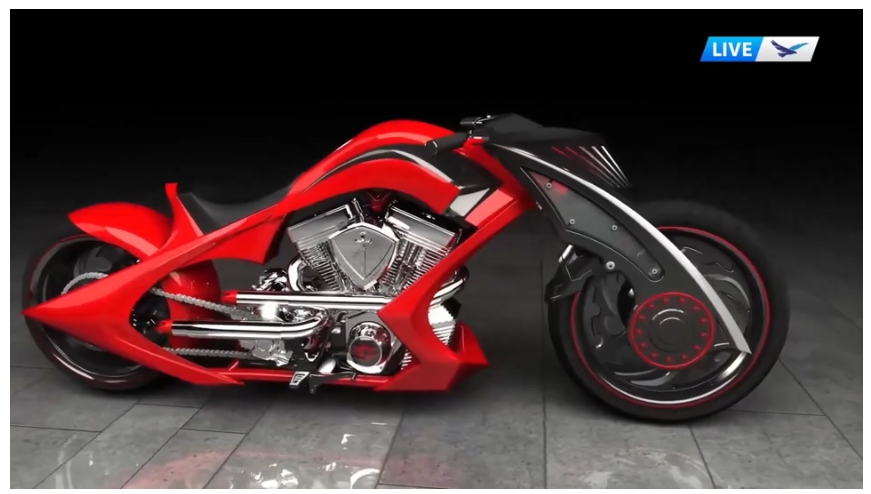
Billy Joel made fun of my haircut, which—which was funny because he didn’t have hair. Tony Stewart. It goes on and on. We did a bike for Shaq that was really cool because he’s just a huge person. So, like, no one in the shop could actually ride the bike that we made. My buddy Christian, our lead mechanic…we made him like stilts so he could shift gears, and he sat on top of the gas tank. It was huge.
I got to work with all sorts of Fortune 500 companies, and I got to work with their ad agencies, and it really put me in a fortunate position. I got to travel the entire world, and I really cherish those moments that I was able to learn from the insanely talented team I got to work alongside and other people that really contributed to my role and success there, which was awesome.
Damon: You got to take a lot of these folks through the full engineering process, show them what it looks like to design something and prototype it and test it, and that’s a unique opportunity.
Jason: I basically [have] a four-part creative design process.
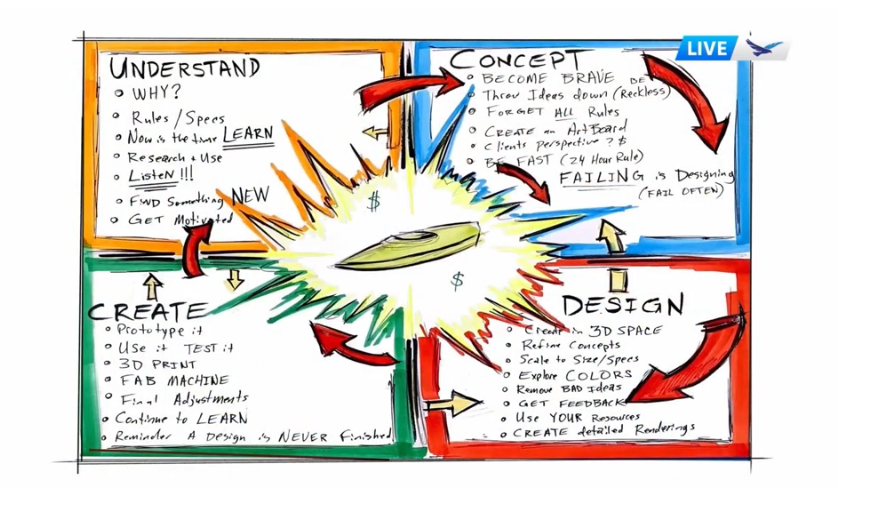
The first part is understanding what exactly you’re trying to do. Is this a personal project for you to make you happy, bring you joy? Is it what the client needs? What does the competition look like?
And then the second phase — that’s doing the quick concept sketches, maybe adding a splash of color, maybe knocking [out] a quick model.
[In] the third phase, I sit back and try to work in the details in 3D space, generate an amazing SOLIDWORKS file, something that’s manufacturable.
The final phase is the creation phase or the make phase. That’s where I do the 3D printing or the CNC milling or welding.
It’s endless. How you can [so easily] make things these days is really tremendous. And that’s what I love.
I love the whole maker movement, how you can access equipment at different fab labs, [and] how you can get lower cost equipment. That you could never do before. And it’s really brought the power of design and manufacturing to the maker, [to] someone that just wants to create and build. That’s what I’m here for. I’m here to have fun and keep on building and keep on designing.
Damon: It IS pretty exciting. There are millions of budding designers all over the world who really that have this opportunity now that they didn’t really have in the past. You’ve obviously got a passion for not only being creative, designing new things, but sharing that philosophy with others. Is that why you decided to go work for SOLIDWORKS?
Jason: Yeah. That’s exactly why. When I was traveling a lot back in the day, I’d go to airports, and I’d have a college kid run up to me. “Oh, hey, Jason Pohl.” “I’d be like, yo. What’s up?” And they’d [say] “Oh, I went to engineering school because of you. I’m a mechanical designer because of you. I saw you drawing bikes on that — on that glass tablet, and I saw you dream 3D. It opened my eyes up to product design.”
I had an art teacher back in high school that opened my eyes up to [the idea that] the whole world is designed.
You can design it how you want. You could be the creator of all these different things. And that inspired me. I [have a huge] desire to help influence and inspire the next level of industrial designers. And what better place to do it and have the power to still be super creative, use state of the art tools, get to test drive them first, and make sure they’re ready?
“I [have a huge] desire to help influence and inspire the next level of industrial designers.”
It never hurts to surround yourself with really smart people. SOLIDWORKS has done it right for so many years that I just feel honored to be part of the team. I really do.
Damon: Where else have you been sort of testing your skills lately? I’m hearing that you’ve been doing some stuff for the sporting world?
Jason: I definitely have a passion for sports. There’s no doubt about that. And recently, I just finished a fan Zamboni for the New Jersey Devils, which they use to give fans rides in between the periods of [the] hockey [game].
I also make all the WWE championship belts. I’ve worked with them since 2006. I machine those right here on the CNC mill behind me.
Damon: Now that you’re at SOLIDWORKS, you’re an industrial design champion. Tell us more about what that means. What do you do at SOLIDWORKS?
Jason: I show that the dream is possible.
Growing up, I had a lot of clients and client visits and bike unveils. I traveled a lot. And people would always approach me and say that I inspired them and motivated them to be a designer or an engineer.
That stuck with me.
I wanted to be able to help people and influence people to make cool choices and build fun things and just have fun with life because that’s what it’s about.
[At SOLIDWORKS], I design and make products. I capture my entire process. I show off my workflows. And then I post them on the Made in 3D community on the 3DEXPERIENCE SWYM platform.
Damon: The SOLIDWORKS forums have always been a big part of that, and they’re part of the 3DEXPERIENCE platform now.
Jason: I love the SWYM platform because it’s a great resource to see what other makers are creating, designing, and building. And a lot of times, I get inspired by others there for my projects. I’m the industrial design champion on the mainstream innovation adoption team, which is led by Justin Burton.
Damon: You’ve been working with a lot of our favorite folks at SOLIDWORKS. You’ve been doing so many cool projects as a test case to share what these tools can do. What’s a recent one you’ve been working on that you’re all proud of?
Jason: The recent one I’ve been working on, over the last sixty days, is a really special project for the SlugMe 10 team. I’ve been part of it with everyone at SlugMe—this is my fifth year doing SlugMe. We have something really special that airs on YouTube November sixth. Everyone should check it out. We picked a topic that was intimidating to me and others. I really wanted to see if we could do it and if the new tools were up to the ultimate test. I was amazed. I was blown away, and I’m just so happy to be part of it. We used xDesign and xShape and created and built an amazing sculpture. It’ll be on display November sixth on YouTube, and everyone will get a chance to see it up close at 3DEXPERIENCE World in Houston, Texas next year.
Damon: 2026, Houston. We are heading back to Houston next year for 3DEXPERIENCE World. There’s always lots of cool stuff on the show floor. We’ll have to keep our eyes out for that one. For those who aren’t familiar, the SlugMe event is in the spirit of the SOLIDWORKS user group community. A lot of folks have been to SOLIDWORKS user groups this year more than in the last few. We’ve been proud to participate in them at Hawk Ridge, and we’re excited to see that momentum.
Jason: Yeah. I’ll also be speaking at a couple of sessions at 3DEXPERIENCE World in Houston. I have a meetup session next to the sculpture, which will be really cool. I’m also hosting my own session called “Limitless Design Using xShape.” It’s basically an industrial design focus and shows a little more about my workflow.
Damon: I don’t want any spoilers, but can you give us a sneak peek? What are you going to cover in this session? What are your go-to xShape master tips?
Jason: It’s a whole bunch of things—it’s just my process: how I use the software, my day-to-day use of it, even using Leanboard to be successful with my projects. Also, there’s a guy who looks a lot like me that’ll be a participant at the Model Mania Extreme event. You definitely want to check that guy out. They tell me he’s pretty good.
Damon: Okay. I took my hand at the SOLIDWORKS ’95 challenge last year and I think I won a SOLIDWORKS ’95 CDK, so I must have done okay. But we’ll have to find you a worthy competitor there.
Jason: That’d be great.
Damon: You clearly have the passion, the skill, and the enthusiasm to share all of that with our community and others out there. We couldn’t be more grateful. Thanks so much for taking some time out of your day to chat with us. We can’t wait to see what else you’ve got in store.
Jason: Yeah, absolutely. Thanks, Damon, so much. Anytime I can work with Hawk Ridge, I’m gonna do it. I appreciate you guys so much.
Damon: Thanks again. Amazing stuff. Thanks again to Jason Pohl for taking us behind the scenes in his world!
Frequently Asked Questions
What is Jason Pohl’s background and how did he get into industrial design?
Jason Pohl has always been driven by a passion for drawing, designing, and building things that bring joy to others. He started with art and sculptures, then moved into the video game industry before joining Orange County Choppers, where he became known for designing custom motorcycles. His love of creating emotion through design eventually led him to become the Industrial Design Champion at SOLIDWORKS.
Which celebrities has Jason Pohl designed custom bikes for?
Over the years, Jason has designed bikes and parts for many high-profile clients, including: Will Smith (the iRobot bike), Muhammad Ali, Bill Murray (the Caddyshack bike), Billy Joel, Tony Stewart, and Shaquille O’Neal (a massive bike scaled to his size.) He has also worked with Fortune 500 companies and their ad agencies on various projects.
What was Jason Pohl’s first project in SOLIDWORKS and how did itimpacthim?
His very first model in SOLIDWORKS was a simple three-spoke motorcycle wheel. He describes it as a basic design that now makes him laugh, but at the time it was transformative. SOLIDWORKS gave him precise control, real-world dimensions, and the ability to go straight from digital design to manufacturing (e.g., sending parts to the water jet), which he says “gave me power” and made his dreams possible.
What design tools does Jason currently use and recommend in the SOLIDWORKS ecosystem?
Jason frequently uses:
- xShape for fast sub-D (subdivision) modeling and quick 3D concept exploration
- xDesign for rapid cloud-based concept work
- Leanboard (3D Lean) for collecting inspiration, sketches, reference images, notes, and material links in one place
He often starts with pencil sketches, builds an inspiration art board in Leanboard, then jumps into xShape or xDesign before refining detailed models in full SOLIDWORKS.
What recent projects has Jason Pohl been working on?
Recent highlights include:
- Designing and machining WWE championship belts (ongoing since 2006)
- Creating a fan Zamboni for the New Jersey Devils
- Leading a special sculpture project for the SlugMe 10 team (displayed at 3DEXPERIENCE World in Houston in 2026)
He is also preparing to speak at 3DEXPERIENCE World 2026, including a session called “Limitless Design Using xShape” and a meetup next to the SlugMe sculpture.