In the fast-evolving world of manufacturing, you need precision, speed, and flexibility to keep up with industry leaders.
For some industries, these are the bare minimum requirements in today’s market. Without them, you could be swept under the rug.
One machining process that offers these qualities is wire electrical discharge machining (wire EDM) — a technology that has revolutionized how manufacturers create intricate, high-precision components.
What Is Wire EDM?
Wire EDM, or CNC wire cut electrical discharge machining, is a non-traditional machining process that uses a razor thin, electrically charged wire to cut conductive materials.
Rather than relying on mechanical force, the process removes material through a series of rapid, controlled electrical discharges between the thin wire and the workpiece. This allows manufacturers to produce extremely fine, detailed shapes with tight tolerances that are difficult or impossible to achieve with conventional cutting tools. Think of it like using dental floss instead of a knife to cut baked goods.
Because the process does not exert mechanical stress on the material, wire EDM is especially effective for machining hard metals, such as hardened steel, titanium, and superalloys.
The result is a remarkably smooth surface finish and precise geometry. It’s the perfect way to cut components that require an extremely high level of accuracy and reliability — down to a thousandth of an inch!
Who Uses Wire EDM?
Wire EDM gives manufacturers flexibility to cut intricate profiles and angled features — often with faster turnaround and lower cost than many traditional cutting methods.
Key variables such as wire material, wire diameter, cutting speed, current, and voltage also play an important role, and adjustments to any of these settings can affect the final part quality.
Because of these advantages, many industries rely on wire EDM to produce highly precise components, such as gears and complex molds.
Here are a few key industries and examples of products that use wire EDM to produce.
| Industry | Products That Use Wire EDM |
| Aerospace | Turbine blades, intricate airframe parts, and precision fasteners that must meet strict safety standards |
| Medical | Surgical instruments, implants, and diagnostic devices that require flawless finishes and micron-level accuracy |
| Automotive | Components such as engine and transmission parts that endure extreme conditions |
| Electronics & Semiconductor | Miniature connectors and components that require exact dimensions and ultra-clean cuts |
| Tool & Die Making | Complex molds, punches, and dies that require fine detail and accuracy |
3 Popular Wire EDM Software Available
As powerful as wire EDM technology is, achieving its full potential requires the right programming and automation tools. Let’s take a look at three popular types of wire EDM software and review their capabilities.
- CAMWorks Wire EDM Pro
- ESPRIT Wire EDM
- Mastercam Wire
At-A-Glance Comparison
Here’s a quick comparison of the most popular wire EDM products on the market. We’ll dive deeper into each one later in this blog.
|
Criteria |
CAMWorks Wire EDM Pro |
ESPRIT Wire EDM |
Mastercam Wire |
|
Best For |
SOLIDWORKS-centric teams who want automation + associativity and to minimize CAD/CAM handoffs. |
Shops that want machine-aware programming, strong OEM-tuned workflows, and (when applicable) more advanced setups like brand-optimized wire EDM. |
Teams that want a widely used, general-purpose wire EDM package (especially if they already standardize on Mastercam). |
|
Core Strength(s) |
Fully integrated in SOLIDWORKS with automation like solid to G-code and feature-driven workflow (especially attractive for repeatable die/punch/profile work). |
All-in-one EDM cycles (wire/tank, rough, tabs/slug handling, skim) + machine-specific knowledge/cutting conditions and factory-developed posts positioning. |
Strong set of 2–4 axis wire paths and day-to-day controls (wire motion/angle, entries/exits, etc.). |
|
Key Limitation(s) |
Most powerful results require upfront process database/standards setup (machines, models, posts, cutting conditions) compatible with your shop. |
Typically a heavier upfront setup/implementation mindset (virtual-twin/machine-aware approach); can feel more system than lighter EDM software. |
No longer native inside SOLIDWORKS via the old add-in (it was retired), so SOLIDWORKS users typically rely on file import/translators rather than a true single-window CAD/CAM experience. |
|
Learning Curve |
Low–Medium (if you already live in SOLIDWORKS); Medium overall (once you factor in automation and standards setup).
|
Medium–High (especially when you’re leveraging machine awareness/virtual twin concepts deeply).
|
Medium (lots of training and community, but you’ll still need solid wire EDM process knowledge and post confidence).
|
|
Integrations |
True single-window SOLIDWORKS integration; associativity and shared file context. |
ESPRIT EDGE FX (free add-in) for CAD data exchange that retains a link back to CAD; docs also call out options like Onshape import access. |
Broad CAD exchange via file translators; plus an ecosystem of third-party add-ons. |
1. CAMWorks Wire EDM Pro
CAMWorks is a CNC programming software that lets you generate toolpaths, simulate machining, and post G-code. It uses machining features and an editable knowledge base to standardize best practices and speed up programming across parts, teams, and machines.
CAMWorks Wire EDM Pro is designed specifically for advanced wire EDM machining. It integrates with CAMWorks and SOLIDWORKS to streamline the entire process — from setup to simulation to code generation.
By automating complex programming tasks, CAMWorks Wire EDM allows machinists to focus on productivity rather than repetitive setup work. Whether creating simple 2D contours or intricate 3D geometries, the software ensures that every cut is optimized for quality and efficiency.
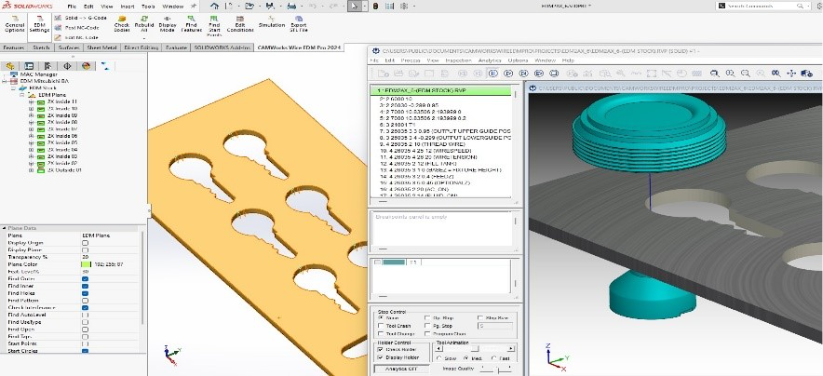 CAMWorks Wire EDM automates the toolpath programming for cutting a key, freeing machinists from repetitive setup work.
Key Features and Advantages
CAMWorks Wire EDM Pro has several strengths. One of which is its advanced toolpath generation, which automatically calculates the most efficient cutting paths to reduce machining time and improve part accuracy.
Its real-time wire path simulation gives users the ability to visualize the machining process before running it, allowing them to detect potential collisions, verify geometries, and optimize strategies within a virtual environment.
Here are additional features:
Wire EDM Programming Capabilities
- 2-axis through full 4-axis wire EDM programming (including 2-axis with taper or draft-wall style parts)
- Feature-based wire EDM (built specifically for EDM) rather than modified milling commands for EDM workflows
- Automatic land and taper detection/toolpaths
Productivity Features
- Its integrated post-processor generates fully optimized G-code for each specific machine configuration, while advanced taper cutting capabilities make it possible to produce the precise angled cuts.
- Automatic Feature Recognition (AFR) for EDM features (punch/die/profile) including imported solids (STEP/IGES/SAT, etc.)
- Automation for rough/skim/tab-style cutting workflows (part of its EDM operations/positioning)
- Optional glue-stops for slug removal (as part of the automated workflow)
- Automatic technology assignment that intelligently selects parameters like wire diameter, cutting speed, and feed rates for each task, minimizing setup time and reducing the risk of human error
Cut Condition for Reuse & Consistency
- Includes user preference settings (such as tool offsets, cutting conditions, and start holes)
Setup & Workflow Efficiency
- Fully integrated in SOLIDWORKS (single-window workflow), which helps keep CAD and CAM associative
- Decals for Entry Points, Glue Stops, and Machine Stops (a workflow feature available with CAMWorks Wire EDM Premium)
- Simulation is part of the automated workflow, so you can review before running
Compatibility
- Supports a wide range of EDM machine brands, such as Mitsubishi, Sodick, and AgieCharmilles.
2. Esprit Wire EDM
Hexagon’s Esprit CAM is a full-spectrum CNC programming software, with capabilities like multi-axis machining, virtual twin simulation (like testing for collision detection), and wire EDM.
Key Features and Advantages
Wire EDM Programming Capabilities
- Automates programming of 2-axis and 4-axis contouring paths
- Land and taper support (including varying tapers and advanced conics) for 2-axis contouring on open/closed profiles
- True 4-axis synchronization (upper/lower profiles) that supports complex contours with precise XY/UV synchronization (complex parts are created as 4-axis ruled features)
- Rotary EDM (indexing + continuous rotary turn-while-burn) for machines that support rotary motion
Productivity Features
- Allows for unattended machining focus, classifying ops into roughing, skimming, and cut-off, then optimizes sequencing across multiple features/workpieces to reduce operator intervention
- Slug management, tabs, and slugless pocketing to further reduce supervision
- No-core pocketing (2-axis and 4-axis) for cavities where slugs are too small/complex to remove (erodes away internal material without creating a slug, with multiple patterns)
- EDM sorting tools to automatically sort and sequence EDM operations by criteria you choose
Cut Condition for Reuse & Consistency
- Machine-specific technology pages (by OEM): gives ready access to each manufacturer’s EDM cutting technology and methodologies, and supports generic EDM technology
- EDM Expert System with XML cut data lets you choose cut data for specific machines, with the data stored in XML for easy updating
- OEM-specific cut-data workflows (e.g., AgieCharmilles) where sequence files and OEM expert systems may be used
Setup & Workflow Efficiency
- Factory-certified post processors to help output reliable machine-ready code
- Feature properties carry key intent (thread location, start point, cut direction, taper angle, land height, corner styles), which helps keep programming consistent and editable
- Rotary feature intelligence includes rotary-specific features that help keep the wire steady during continuous rotation, and standard EDM features can carry workpiece orientation info to make indexing rotation automatic
3. Mastercam Wire
Mastercam Wire is a powerful CAD/CAM tool focused on giving CNC wire EDM programmers precise control, efficient workflows, and adaptable strategies for both simple and complex wire EDM machining needs. It is part of the broader Mastercam suite.
Key Features and Advantages
Wire EDM Programming Capabilities
- 2-axis and 4-axis wire paths for everything from simple profiles to more complex synchronized motion
- Straight or tapered cutting (and control over taper angles along the contour)
- Control over wire motion, angle, entry/exit (lead-in/lead-out) to dial in how the wire approaches/leaves the cut
Productivity Features
- Efficient tab creation and management, plus complete tab control (helpful for slug retention and part stability)
- No-core cutting options for certain workflows
- Ability to cut multiple contours in one operation and sort chains to control motion and order
Cut Condition for Reuse & Consistency
- User-customizable wire libraries to store power settings and registers for rough and skim passes so you can reuse settings
- Corner control (settings for corner types) to help manage accuracy and finish in corners
Setup & Workflow Efficiency
- Move a single part file between machines when you need to run the same job on different equipment
- Thread point support in the workflow so the wire threading location can be defined and stay associative to the model
Which One Is the Best?
There isn’t a single “best” wire EDM CAM for everyone — it depends on what you’re optimizing.
Mastercam Wire tends to be the better pick if you want a widely adopted, straightforward Wire EDM workflow with strong day-to-day essentials like moving one part file between machines, user-customizable wire libraries for rough/skim registers, and built-in controls for tabs, corner types, and taper settings — especially if your shop already runs Mastercam for mill/lathe and wants consistency.
If your goal is maximum automation inside SOLIDWORKS, CAMWorks Wire EDM Pro often wins on speed-to-code because it’s built around a solid to G-code in one click automation (auto-detect features, generate operations/toolpaths, and post).
On the other hand, ESPRIT can be the better choice when you’re pushing more complex wire EDM workflows (including feature-driven programming and cases like rotary wire EDM, where ESPRIT EDGE documentation calls out specialized features to keep the wire steady and automate indexing orientation).
Final Note
Wire EDM can help companies produce parts faster, more accurately, and more efficiently. Whichever software you choose, you’ll be adding robust capabilities as well as precision and productivity to your workflow, helping your shop remain competitive in today’s marketplace.
Need help deciding which wire EDM product is right for you? Reach out to us. We’ll be happy to help.