Many parts are finished with coatings such as paint or plating, or intended to be covered by an exterior protective layer such as insulation. Often times it’s sufficient to represent a coating with a specification callout on an engineering drawing or as an appearance within the CAD model for rendering purposes. In some cases though, it may be desirable to have a separate body representing the coating in CAD, which allows predicting the volume or weight of the coating. In this blog and the accompanying video I’ll detail a technique for accomplishing this using the Surfacing commands in SOLIDWORKS.
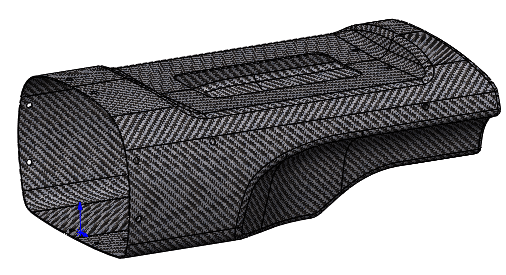
I would like to create a coating around the composite part below. In this case I’ll be creating the coating as a separate body within the part, but it’s also possible to use this method in-context at the Assembly level to create the coating as a separate part file if desired.
 Offset Surface starts the coating model, and setting the offset to zero switches it into a Copy Surface command.
 Entering zero for the offset flush with the exterior faces turns Offset Surface into a Copy Surface operation.
 Select Tangency helps grab all exterior faces at once before accepting the copied surface.
 Accepting the copied surface creates a zero-thickness shell that will next be thickened into the coating.
 All exterior faces are selected here to build the zero-thickness surface before thickening it into a coating.
Now we have created a surface (essentially a zero thickness body) that represents the outside shape of our part. To turn this surface it into a body representing the coating, we will thicken it. Choose the Thicken command from the Surfaces tab once again.
 Clearing Merge result keeps the thickened coating as its own body for later volume and mass estimates.
 With Merge result off, this 0.25-inch thicken operation produces a coating body separate from the part.
 The separated coating body lets you estimate paint volume and mass directly in SOLIDWORKS.