SHOPPING CART
SHOPPING CART
Basics of the Sweep Feature in SOLIDWORKS

Basics of the Sweep Feature in SOLIDWORKS

Table of Contents


If one just looks at the name “sweep feature”, it’s not readily apparent what
this actually is. In my mind I hear “Sweep the leg!” from the first Karate Kid, which can’t possibly be correct. In all
seriousness, when it comes to
SOLIDWORKS,  the sweep is a powerful tool to create useful geometry when a regular boss
won’t work. Using a sweep isn’t as confusing as it seems. The spoke of this
wheel is an example of a swept boss/base:
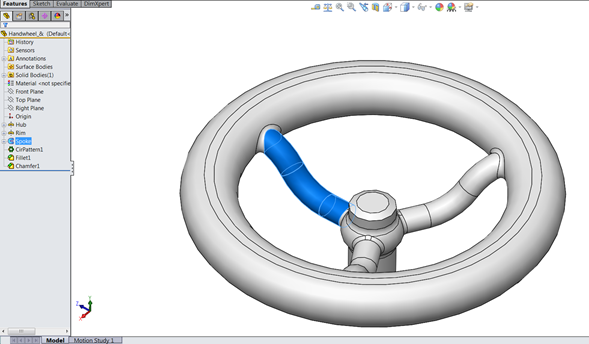
Steering wheel model built with the SOLIDWORKS Sweep feature
A steering wheel model demonstrates the swept boss/base feature covered in this basics guide.

I will be referring to the swept boss/base feature for this article, but the
principles apply to a swept cut as well. The basics of a sweep are:

  • Uses a minimum of 2 separate entities: a profile and a path; also, guide
    curves can be used to control the shape
  • The path must intersect the plane of the profile

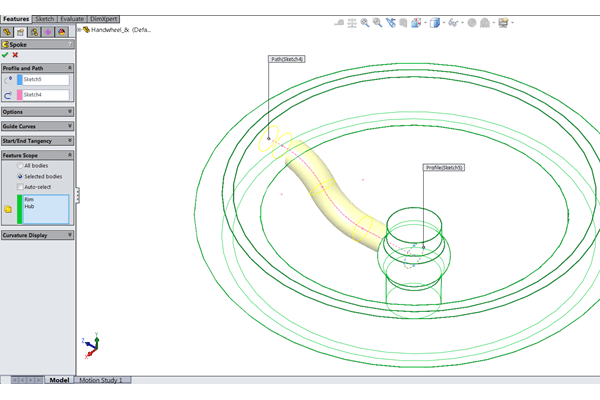
The “profile” is the shape that you want the outside of the sweep to have, and
the “path” is what you want the profile to travel along/follow. In the spoke
example, the profile and path sketches are identified and highlighted as blue
and pink respectively:
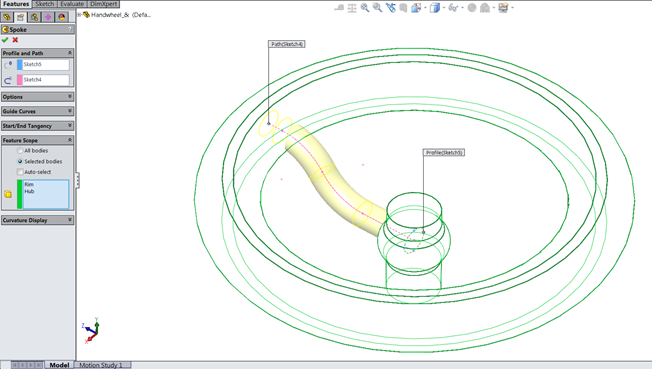
SOLIDWORKS sketch showing a profile and path curve set up for a sweep feature
A profile sketch and path curve set the stage for the sweep feature, though complications can follow.

Seems simple enough right? However…

In my experience, the first condition is pretty intuitive, but the second
condition causes the most confusion. Here is an example of two sketches that
won’t create a sweep because the path isn’t intersecting the profile plane:
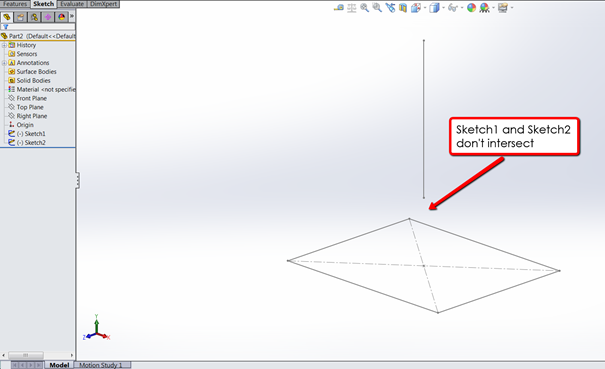
SOLIDWORKS sketch showing that Sketch1 and Sketch2 do not intersect
Sketch1 and Sketch2 fail to intersect here, the problem the Pierce Relation is used to fix.

The simplest way to make sure both sketches intersect is to use the Pierce
Relation. This relation makes a point pierce an axis, edge, or curve in
another sketch, which is what we are looking for between the profile and the
path of a sweep.

In this case, I’ve selected the endpoint of the vertical line and one of the
construction lines from the center rectangle sketch:
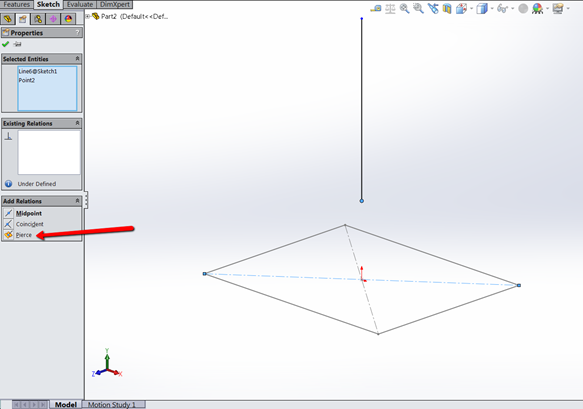
SOLIDWORKS PropertyManager showing a Pierce relation added between sketch entities
Adding the Pierce Relation makes the endpoint and construction line touch as the sweep requires.

Add the Pierce Relation and the endpoint and construction line touch:
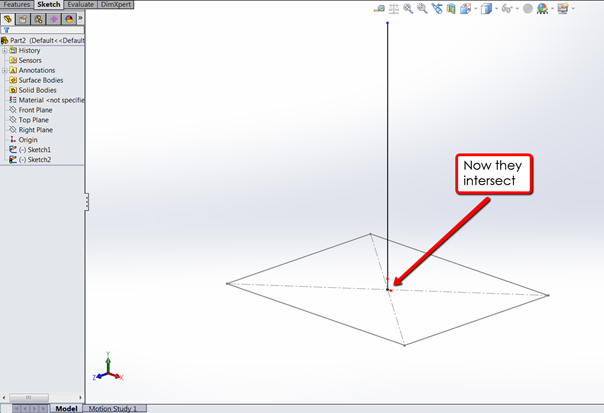
SOLIDWORKS sketch showing Sketch1 and Sketch2 now intersecting after the Pierce Relation
With the Pierce Relation applied, the two sketches now intersect at a shared point.

By adding some more lines and a couple of fillets to Sketch2, my path sketch,
we can make a shape that we couldn’t do with an extruded boss/base and we’re
ready to create the Swept Boss/Base:
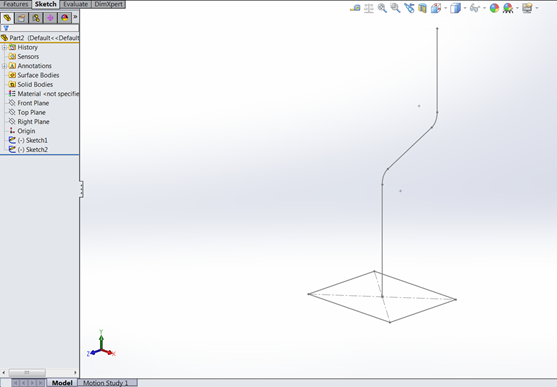
SOLIDWORKS path sketch with added lines and fillets for a swept boss/base shape
The path sketch, refined with extra lines and fillets, creates a shape a simple extrude could not.

Go to the Features tab of the Command Manager and click on the Swept Boss/Base
to go into the feature.

sweep feature

If you have your two sketches selected already, SolidWorks should be able to
auto-populate the Profile and Path field. If these aren’t selected, you can
click on these in the graphics area or from the Flyout Feature Manager Tree.
The blue box is for the Profile and the pink box is for the Path:
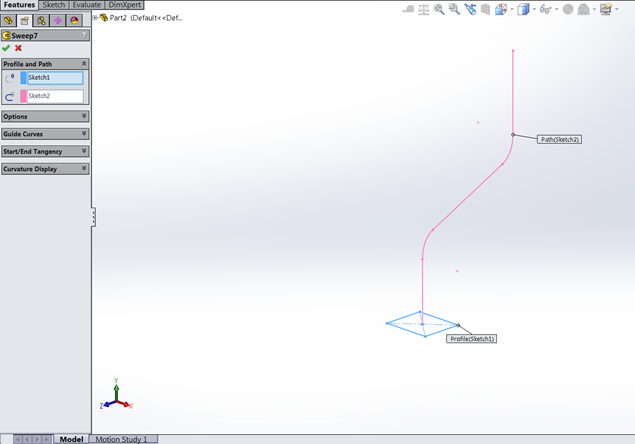
SOLIDWORKS Swept Boss/Base PropertyManager with profile and path sketches selected
Selecting the profile and path sketches in the Swept Boss/Base PropertyManager produces the swept solid.

Just hit the green check and you have a sweep!
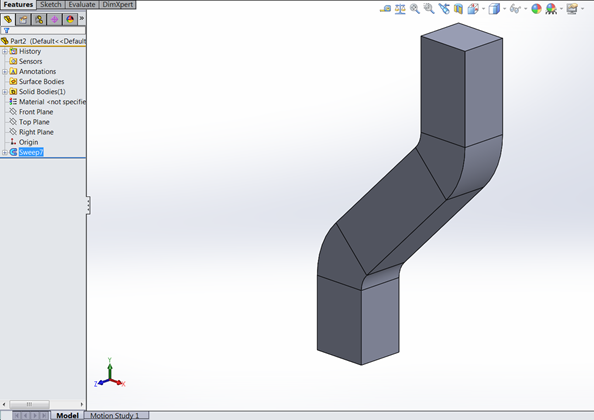
Completed swept boss/base feature forming a bent tube shape
The completed sweep can also be twisted along its path instead of just following it, as covered next.

If a twist is needed in the part, you don’t have to change the path to a helix
(that might be a future blog article…) Within the sweep feature, under the
Options area, the Orientation/twist type can be modified from Follow Path (the
default) to Twist Along Path by hitting the drop down:
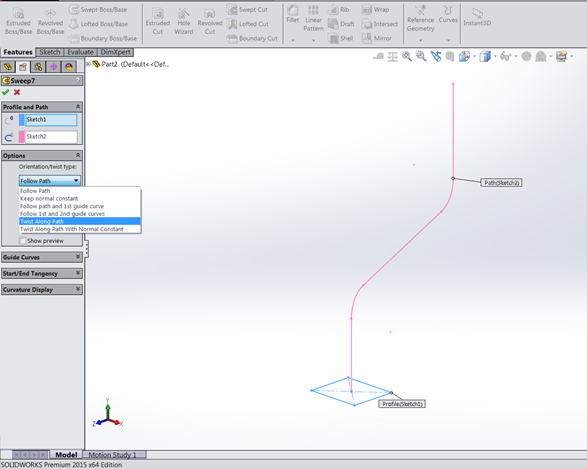
SOLIDWORKS Swept Boss/Base Orientation/twist type dropdown showing Twist Along Path option
Changing Orientation/twist type to Twist Along Path lets the sweep twist as it follows its path.

Select if the twist is defined by Degrees, Radians or Turns, put in the value
of the twist and hit the green check:
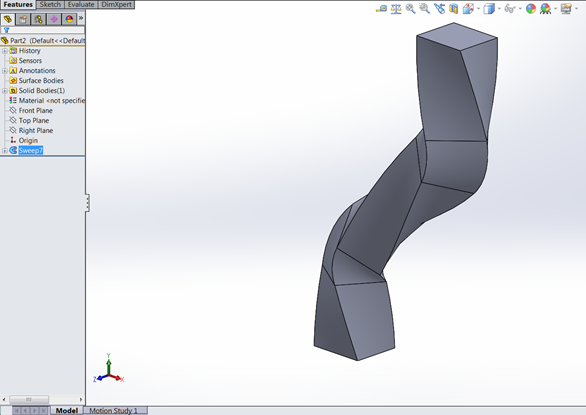
Swept boss/base feature with a twist applied along its path
The twisted sweep result shown here is covered further in the accompanying video on Selection Sets.

For a video of the basic sweep feature, along with an introduction to
Selection Sets, please take a look at
our YouTube video
below.

Good luck sweeping and thanks for reading!

Picture of Vince Farrell

Vince Farrell

Vince Farrell is an applications engineer with a design background in the LED industry. He has over four years of SOLIDWORKS experience in both LEDs and aerospace industries. In his spare time, Vince likes to spend time with family and friends, hit the gym, and travel.

Get a Price Match

Thank you for submitting your quote! A confirmation email is on its way. Please check your spam folder if you do not receive it.

While you are waiting, check out our Resource Center or read our Blog!

Success

Register Now

Thank you for registering! A confirmation email is on its way. Please check your spam folder if you did not receive one. See you soon!

While you are waiting, check out our Resource Center or read our Blog!

success

Register Now

Thank you for registering! A confirmation email is on its way. Please check your spam folder if you did not receive one. See you soon!

While you are waiting, check out our Resource Center or read our Blog!

success

Register Now

Thank you for registering! A confirmation email is on its way. Please check your spam folder if you did not receive one. See you soon!

While you are waiting, check out our Resource Center or read our Blog!

success

Get Your Download Today!

Thank you for your download! We've sent your download to the email address you provided. Please check your spam or junk folder if you don't receive it. It may take a few minutes to arrive.

success